Meetup 7: Joins and SQL
2025-10-06
Lab 3-4 Review: Axes
- Never plot different units on the same axis
airqualitydataset- contains
ozone,solar.R,Wind,Temp
Lab 3-4 Review: Axes
- Never plot different units on the same axis
airqualitydataset- contains
ozone,solar.R,Wind,Temp
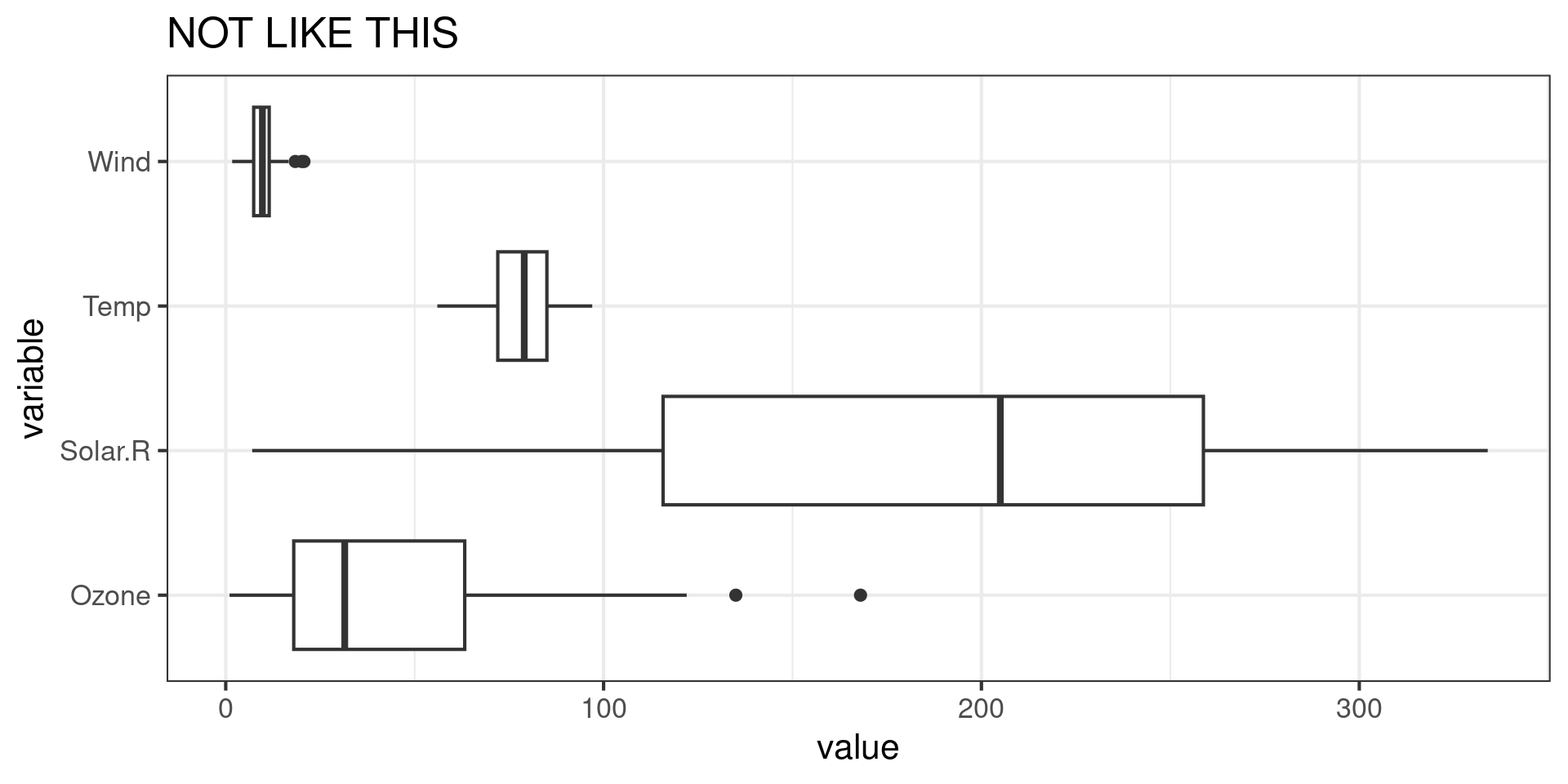
Lab 3-4 Review: Axes
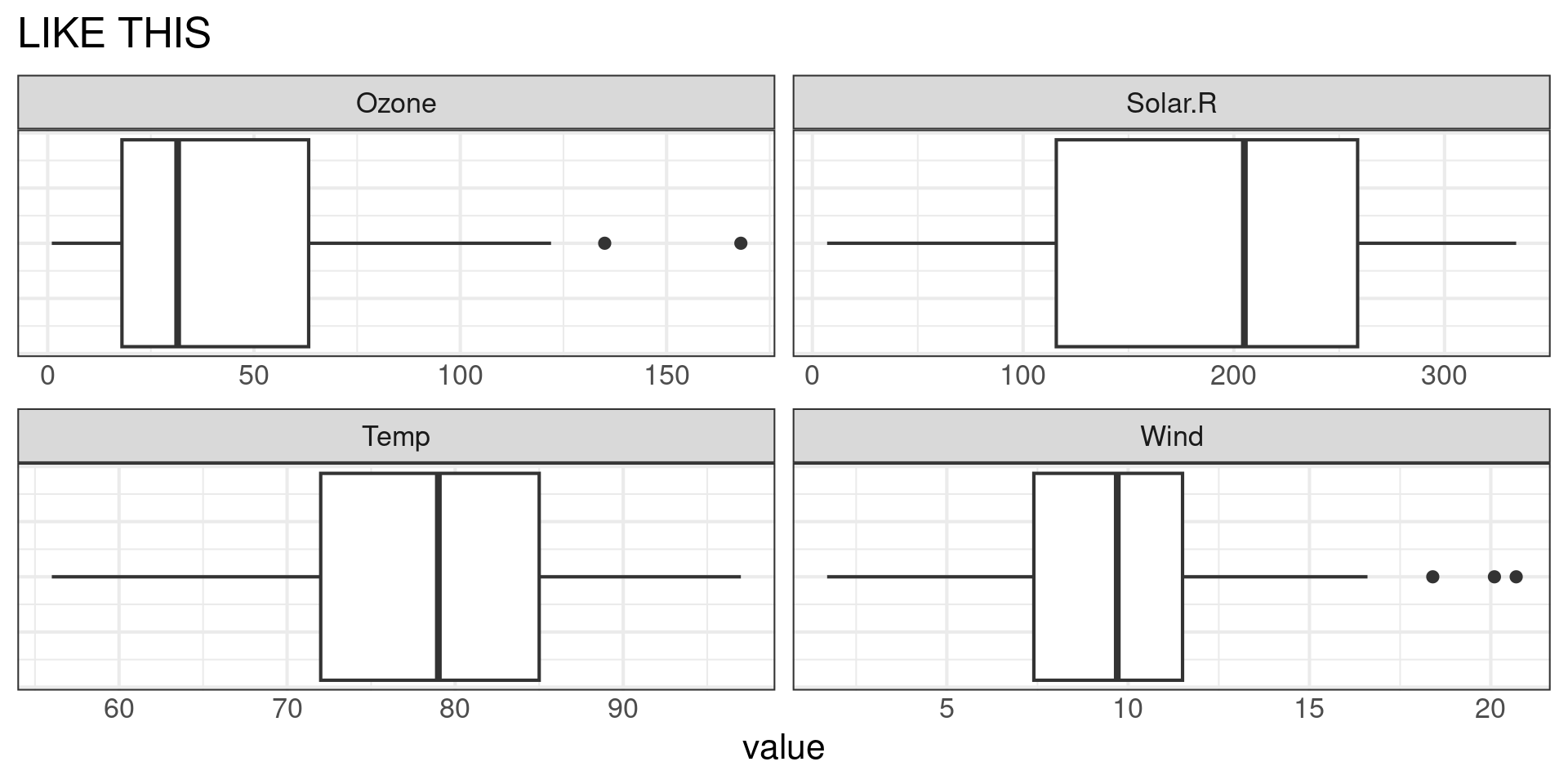
- Instead use facets to make each axis distinct
Lab 3-4 Review: Axes
- Instead use facets to make each axis distinct
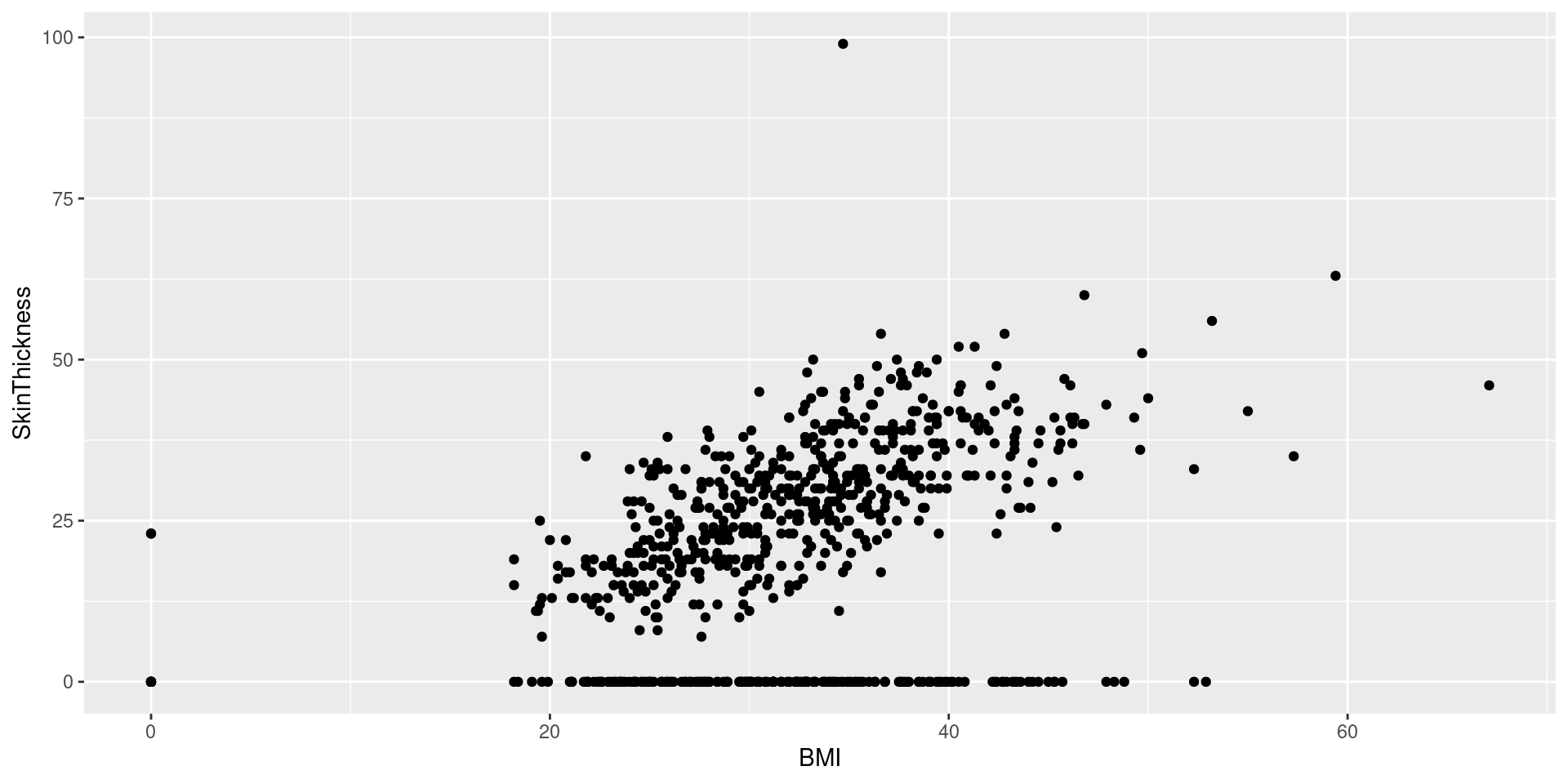
Investigating Outliers
- In the diabetes dataset there was an observation with a skin thickness of 99
- Should we discard this measurement?
- Make scatterplot of BMI vs skin thickness:
Project Proposal
- No lab next week
- But project proposal due October 20th
- Target 2 Pages
- Intro
- Data
- Analysis Plan
- Idea: Demonstrate full data science workflow
- Emphasis on everything but modeling
- Feel free to ask me about your idea as you develop it
Project Proposal
- Pick a topic that either:
- Relates to a specific professional goal or your current job
- Relates to a something you know a lot about
- Is something you have become very interested in
- Read about your topic when developing your proposal!
- Have a short section on with references explaining state-of-the-art
Heilmeier Framework
Developing a Research Proposal: Heilmeier Questions
George Heilmeier developed a series of questions he would ask of potential DARPA grant recipients
The answers to these questions get you to the core of your idea

Heilmeier Questions
- What are you trying to do? (Without Jargon)
- How is it done today and what are the limits?
- What is your approach and why will it be successful?
- Who cares about this question? (Stakeholders?)
- What are the risks/obstacles
- What will it cost? (0$)
- How long will it take? (Deadline)
- What does progress/success look like?
This Week
- Two main topics: Joins and SQL
- Separate video for SQL with a coding vignette
Combining Data From Multiple Tables
- Data usually stored in separate files/data frames
- Analysis requires data in a single frame
- Need tools to combine data-frames
Example: nycflights13
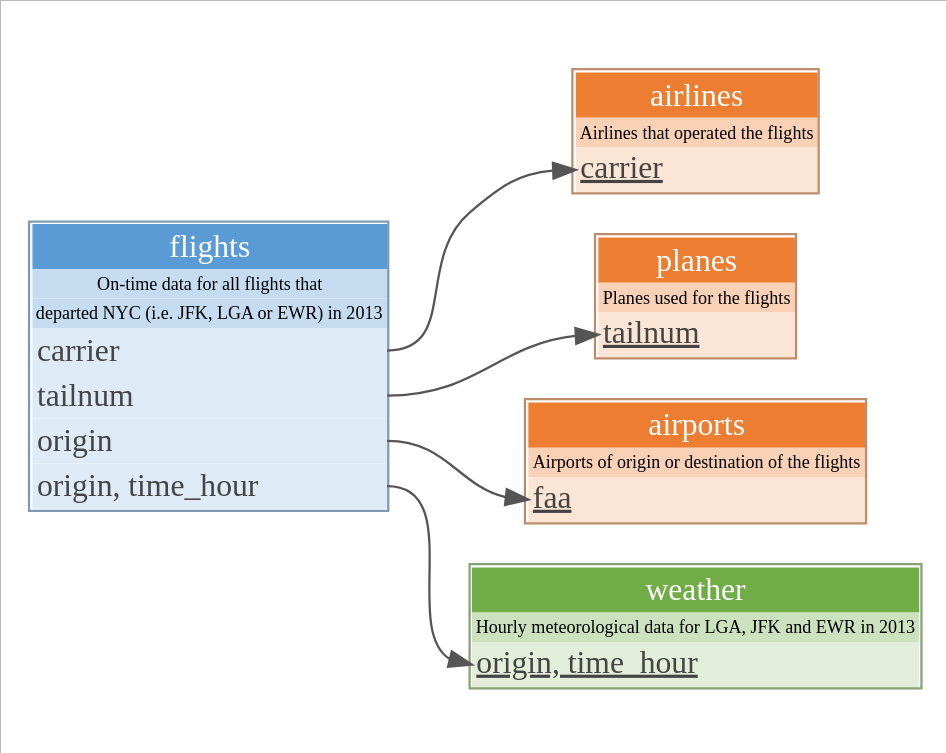
Example: nycflights13
| time_hour | carrier | dep_time |
|---|---|---|
| 2013-01-01 05:00:00 | UA | 517 |
| 2013-01-01 05:00:00 | UA | 533 |
| 2013-01-01 05:00:00 | AA | 542 |
| 2013-01-01 05:00:00 | B6 | 544 |
| 2013-01-01 06:00:00 | DL | 554 |
| 2013-01-01 05:00:00 | UA | 554 |
| 2013-01-01 06:00:00 | B6 | 555 |
| 2013-01-01 06:00:00 | EV | 557 |
Example: nycflights13
Example: nycflights13
| faa | name | lat | lon |
|---|---|---|---|
| 04G | Lansdowne Airport | 41.13047 | -80.61958 |
| 06A | Moton Field Municipal Airport | 32.46057 | -85.68003 |
| 06C | Schaumburg Regional | 41.98934 | -88.10124 |
| 06N | Randall Airport | 41.43191 | -74.39156 |
| 09J | Jekyll Island Airport | 31.07447 | -81.42778 |
| 0A9 | Elizabethton Municipal Airport | 36.37122 | -82.17342 |
| 0G6 | Williams County Airport | 41.46731 | -84.50678 |
| 0G7 | Finger Lakes Regional Airport | 42.88356 | -76.78123 |
Example: nycflights13
- Can combine data frames along rows that share matching values of a common variable:
- Columns which connect different data frames are Keys
Example: nycflights13
- Can combine data frames along rows that share matching values of a common variable:
- Columns which connect different data frames are Keys
Example: nycflights13
- Can combine data frames along rows that share matching values of a common variable:
- Columns that are common “Keys” used to link data frames
Primary Keys
A Primary Key is a column/group of columns whose values uniquely determine each row of the data frame.
- For
planesit istailnum
| tailnum | year | type | model |
|---|---|---|---|
| N10156 | 2004 | Fixed wing multi engine | EMB-145XR |
| N102UW | 1998 | Fixed wing multi engine | A320-214 |
| N103US | 1999 | Fixed wing multi engine | A320-214 |
| N104UW | 1999 | Fixed wing multi engine | A320-214 |
| N10575 | 2002 | Fixed wing multi engine | EMB-145LR |
Definition
A Primary Key is a column/group of columns whose values uniquely determine each row of the data frame.
- For
planesit istailnum
- This count command shows that each row has a unique value of
tailnumproving that it is a primary key
Compound Keys
Sometimes no single variable uniquely identifies rows.
Multiple variables can combine to be a primary key
For
weatherit requiresoriginandtime-hour:
Foreign Keys
A Foreign Key is a variable/group of variables that is a primary key for another data frame.
| flight | time_hour | tailnum |
|---|---|---|
| 1545 | 2013-01-01 05:00:00 | N14228 |
| 1714 | 2013-01-01 05:00:00 | N24211 |
| 1141 | 2013-01-01 05:00:00 | N619AA |
| 725 | 2013-01-01 05:00:00 | N804JB |
tailnumis a primary key forplanes- Foreign key allows for rows to be matched between data frames
Joins
- Joins are functions that combine two data frames
something_join(x,y,by = join_by(...))
- Here
somethingis either:left_joinright_joinfull_joininner_joinsemi_joinanti_join
Join Types
Two main “types” of joins:
- Mutating Joins:
- Combine data between data frames
left_join,right_join,full_join,inner_join
- Filtering Joins:
- Filter rows based on matches
semi_join,anti_join
Mutating Joins
left_join: Keeps all rows ofx, matches/adds fromyright_join: reversedleft_joinfull_join: keeps all rows of bothinner_join: only rows occurring in both
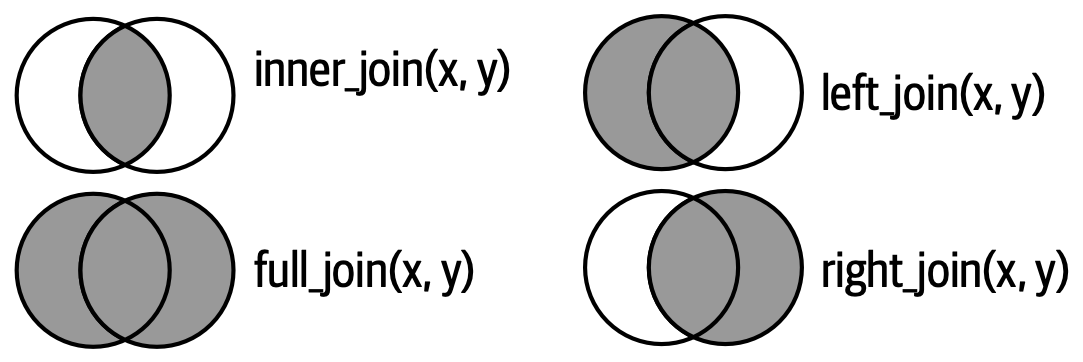
R4DS 19.8
Left Join
- Starting Point:
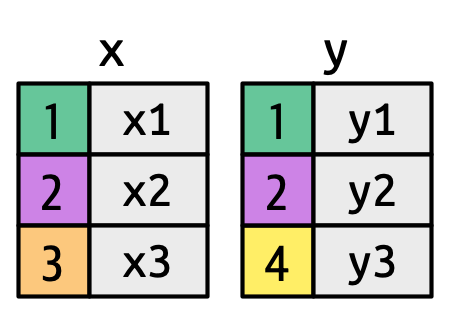
R4DS 19.2
Left Join
R4DS 19.2
Right Join
R4DS 19.2
Inner Join
R4DS 19.2
Full Join
What about Keys?
joinfunctions automatically try to find a foreign key- You may specify a key using
join_byand a formula:
# A tibble: 5 × 6
   year month   day dep_time sched_dep_time dep_delay
  <int> <int> <int>    <int>          <int>     <dbl>
1  2013     1     1      517            515         2
2  2013     1     1      533            529         4
3  2013     1     1      542            540         2
4  2013     1     1      544            545        -1
5 2013 1 1 554 600 -6- Potential for multiple matches and duplication when there is no foreign key
Filtering Joins
semi_join(x,y)removes rows ofxthat don’t have matches iny- Use
semi_jointo restrict airports to the destination airports
# A tibble: 3 × 8
  faa   name                  lat   lon   alt    tz dst   tzone
  <chr> <chr>               <dbl> <dbl> <dbl> <dbl> <chr> <chr>
1 EWR   Newark Liberty Intl  40.7 -74.2    18    -5 A     America/New_York
2 JFK   John F Kennedy Intl  40.6 -73.8    13    -5 A     America/New_York
3 LGA   La Guardia           40.8 -73.9    22    -5 A     America/New_York
Filtering Joins
anti_join(x,y)removes rows ofxthat have matches iny- Use
anti_jointo find implicit missing values - Flights where weather info lacking:
# A tibble: 5 × 6
   year month   day dep_time sched_dep_time dep_delay
  <int> <int> <int>    <int>          <int>     <dbl>
1  2013     1     1     1153           1200        -7
2  2013     1     1     1154           1200        -6
3  2013     1     1     1155           1200        -5
4  2013     1     1     1155           1200        -5
5  2013     1     1     1157           1200        -3
Data Science in Context Presentations
Meetup Reflection/One Minute Paper
Please fill out the following google form after the meeting or watching the video: