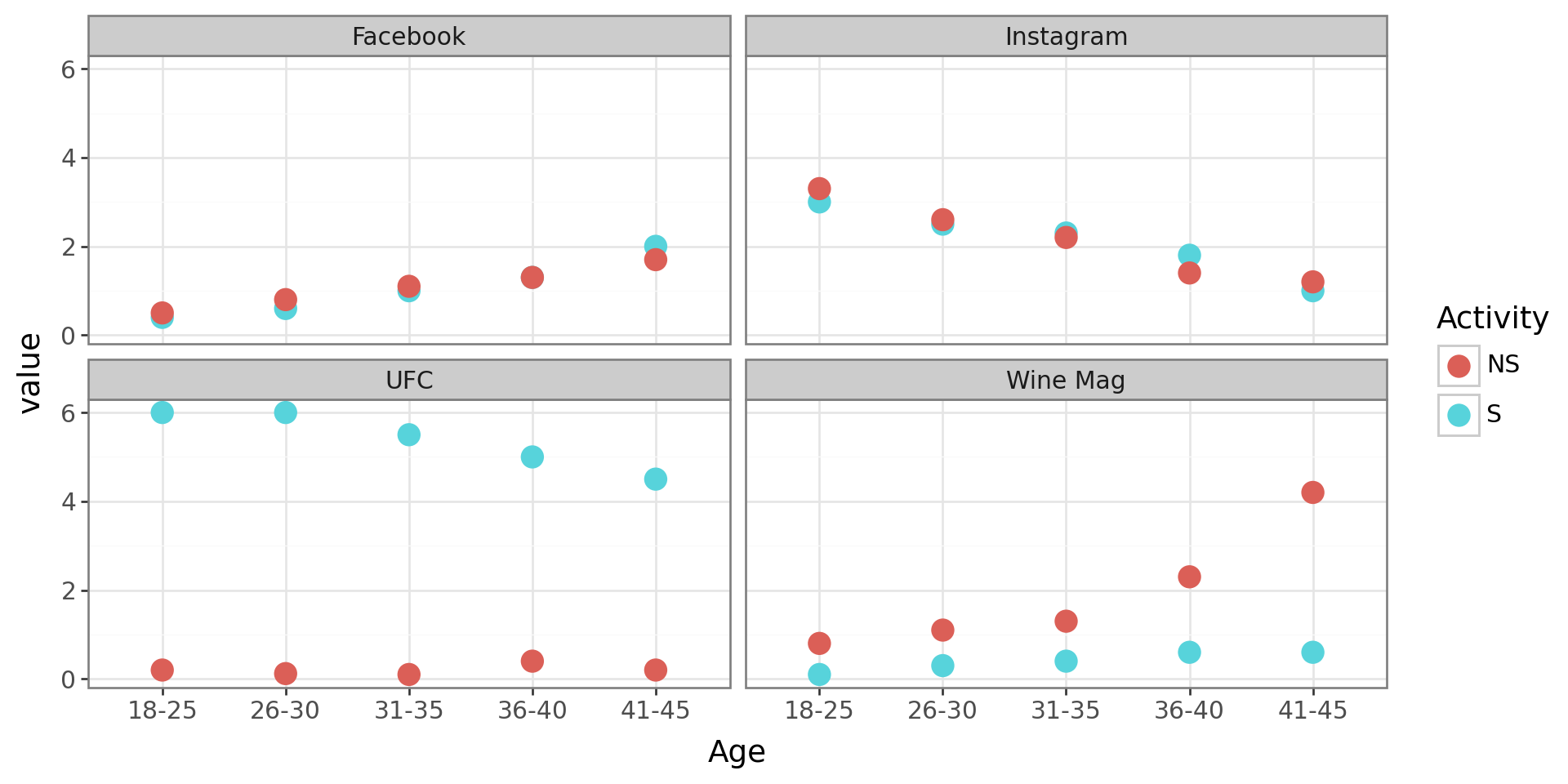
   Instagram  Wine Mag  Facebook   UFC      Demo
0        3.0       0.1       0.4  6.00   18-25 S
1        2.5       0.3       0.6  6.00   26-30 S
2        2.3       0.4       1.0  5.50   31-35 S
3        1.8       0.6       1.3  5.00   36-40 S
4        1.0       0.6       2.0  4.50   41-45 S
5        3.3       0.8       0.5  0.20  18-25 NS
6        2.6       1.1       0.8  0.12  26-30 NS
7        2.2       1.3       1.1  0.10  31-35 NS
8        1.4       2.3       1.3  0.40  36-40 NS
9 1.2 4.2 1.7 0.20 41-45 NSMeetup 2: Least Squares
George Hagstrom
Week Summary
- Starting on Least Squares
- Chapter 12 of VMLS
- Keep working on Lab 1, due this Sunday at midnight
System of Linear Equations
- When can we solve: \[ A\mathbf{x} = \mathbf{b}\,?\]
- \(A\) is an \(m\times n\) matrix
- \(\mathbf{x}\) is an \(n\)-vector
- \(\mathbf{b}\) is an \(m\)-vector
Tall, Wide, and Square Matrices
\(m=n\) square
Exact solution if rows/columns are independent \[ A = \begin{pmatrix} a_{11} & \cdots & \cdots & a_{1n} \\ \vdots & \cdots & \cdots & \vdots \\ \vdots & \cdots & \cdots & \vdots \\ a_{n1} & \cdots & \cdots & a_{nn} \end{pmatrix} \]
\(\mathbf{x} = A^{-1}\mathbf{b}\)
Tall, Wide, and Square Matrices
- \(m<n\) wide
- Generally multiple solutions because dependent columns \[ A = \begin{pmatrix} a_{11} & \cdots & \cdots & \cdots & a_{1n} \\ \vdots & \cdots & \cdots & \cdots & \vdots \\ a_{m1} & \cdots & \cdots & \cdots & a_{mn} \end{pmatrix} \]
- Common ML situation (more parameters than data points)
- Particular solution plus the null space
Tall, Wide, and Square Matrices
- \(m>n\) tall
- Generally no exact solution \[ A = \begin{pmatrix} a_{11} & \cdots & a_{1n} \\ \vdots & \cdots & \vdots \\ \vdots & \cdots & \vdots \\ \vdots & \cdots & \vdots \\ a_{m1} & \cdots & a_{mn} \end{pmatrix} \]
Inspiration for Least Squares
- Can’t solve? Minimize the error \[ \mathbf{r} = A\mathbf{x}-\mathbf{b}\]
- Optimization problem is: \[\textrm{Find:}\quad \min_{\mathbf{x}} \|A\mathbf{x} - \mathbf{b}\|^2\]
- The \(\mathbf{x}\) that minimizes this objective (the squared residual) is the least squares solution
- Linear regression
How to Solve It?
- Take derivative and set to 0: \[ \frac{\partial}{\partial \mathbf{x}}\|A\mathbf{x}-\mathbf{b}\|^2 = 2A^T A\left(\mathbf{x} - A^T\mathbf{b}\right) \]
- Two ways to get that:
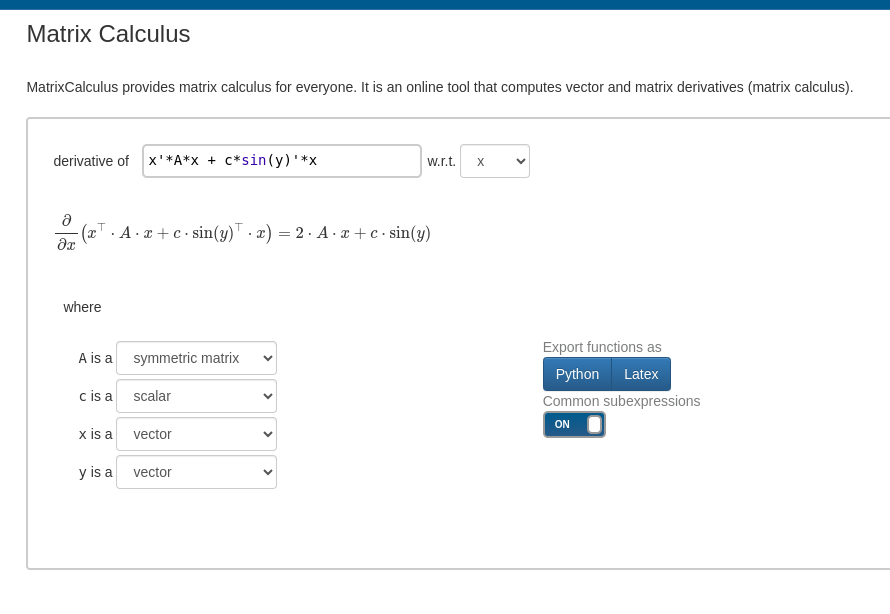
![www.matrixcalculus.org]()
How to Solve It?
- Take derivative and set to 0: \[ \frac{\partial}{\partial \mathbf{x}}\|A\mathbf{x}-\mathbf{b}\|^2 = 2A^T A\left(\mathbf{x} - A^T\mathbf{b}\right) \]
- Two ways to get that
- matrixcalculus.org
- Take derivatives, work with indices
How to Solve It?
- Get System of Linear Equations: \[ A^TA\mathbf{x} = A^T\mathbf{b} \]
- \(A^TA\) is an \(n\times n\) symmetric matrix called the Gram matrix
- Invertible if columns of \(A\) are independent:
\[ \mathbf{x} = \left(A^T A\right)^{-1}A^T\mathbf{b}\]
- This is the exact formula for the least squares solution
Properties
- Morse-Penrose Pseudoinverse: \[A^+ = (A^TA)^{-1}A^T\]
- \(n\times m\) matrix
- If \(A\) is invertible, \(A^+ = A^{-1}\)
Applications: Linear Regression
Suppose you have \(m\) observations, each with \(n\) features
\(\mathbf{a}_{i}\) is \(i\)th obs
Want to predict the variable \(\mathbf{b}\) using an Affine function: \[ \mathbf{a}_i^T\mathbf{x} +c = b_i \]
or
\[ \sum_{j=1}^m a_{ij} x_j + c = b_i \]
Linear Regression
- Augmented matrix \(A\) and coefficients \(\mathbf{x}\): \[ A = \begin{pmatrix} a_{11} & \cdots & a_{1n} & 1 \\ \vdots & \cdots & \vdots & 1 \\ a_{m1} & \cdots & a_{mn} & 1 \end{pmatrix} \] \[ \mathbf{x} = \begin{pmatrix} x_1 & x_2 & \cdots & x_n & c \end{pmatrix}^T \]
- Now get standard least squares problem:
\[ \min_{\mathbf{x}}\|A\mathbf{x}-\mathbf{b}\|^2\]
Applications: Marketing Budget
- You are tasked with spending a marketing budget
- There are \(10\) different demographic groups to target
| Group | |
|---|---|
| 1 | 18-25, play sports |
| 2 | 26-30, play sports |
| 3 | 31-35, play sports |
| 4 | 36-40, play sports |
| 5 | 41-45, play sports |
| 6 | 18-25, no sports |
| 7 | 26-30, no sports |
| 8 | 31-35, no sports |
| 9 | 36-40, no sports |
| 10 | 41-45, no sports |
Applications: Marketing Budget
- You are tasked with spending a marketing budget
- There are \(10\) different demographic groups to target
- 4 different marketing channels
| Channel | |
|---|---|
| 1 | |
| 2 | Wine Mag |
| 3 | |
| 4 | UFC |
Applications: Marketing Budget
- Views: $1 on channel \(i\) gets \(R_{ij}\) views in group \(j\)
Applications: Marketing Budget
- Views: $1 on channel \(i\) gets \(R_{ij}\) views in group \(j\)
Marketing Budget
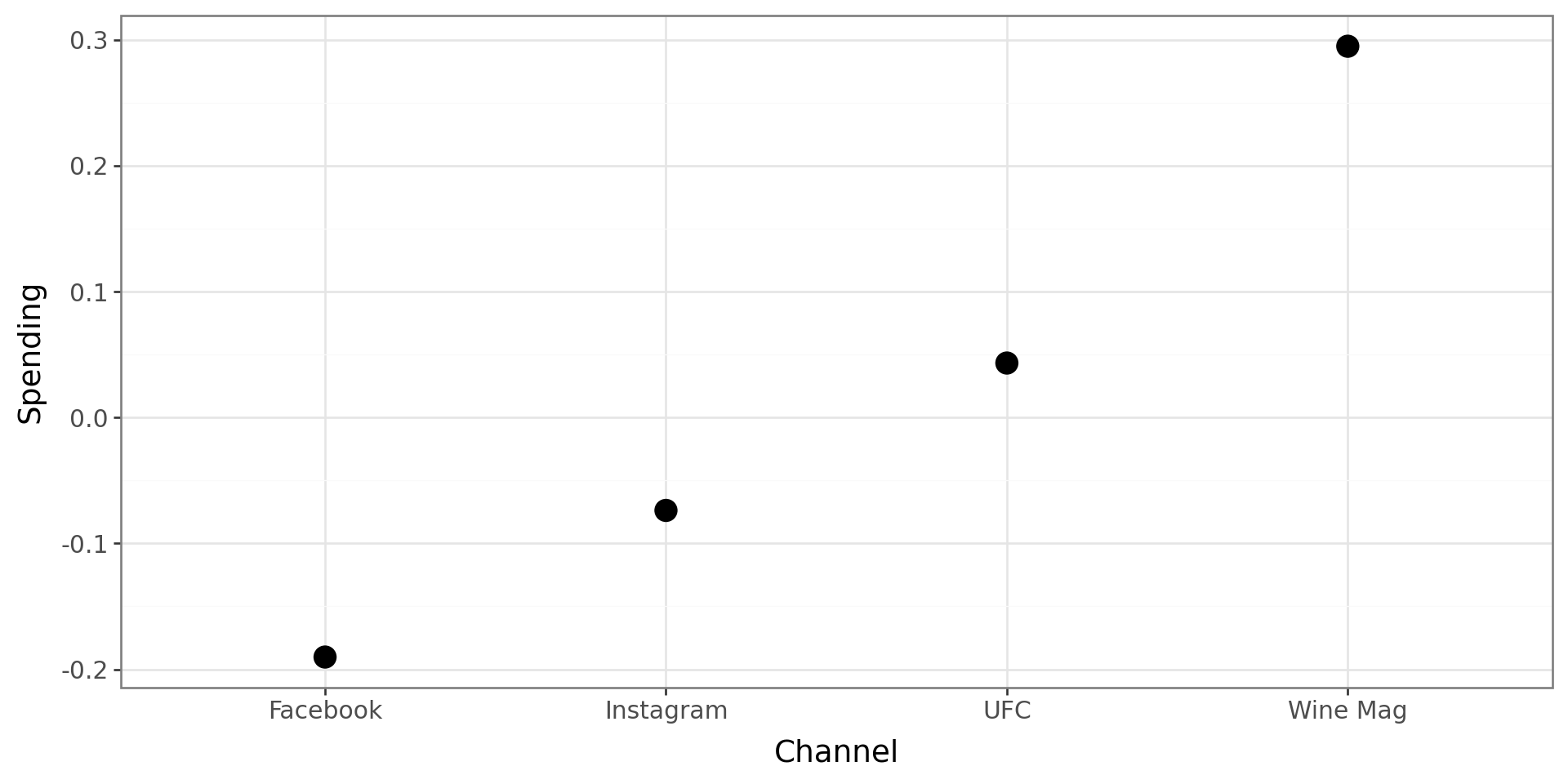
- Problem: spend money to get \(\mathbf{v}_{dem}\) impressions
- Decision variable \(\mathbf{s}\) is spending in each channel
- Solve least squares problem: \[ \min_{\mathbf{s}} \|R\mathbf{s} - \mathbf{v}_{dem}\|^2 \]
- \(R\mathbf{s}\) is views
Marketing Budget
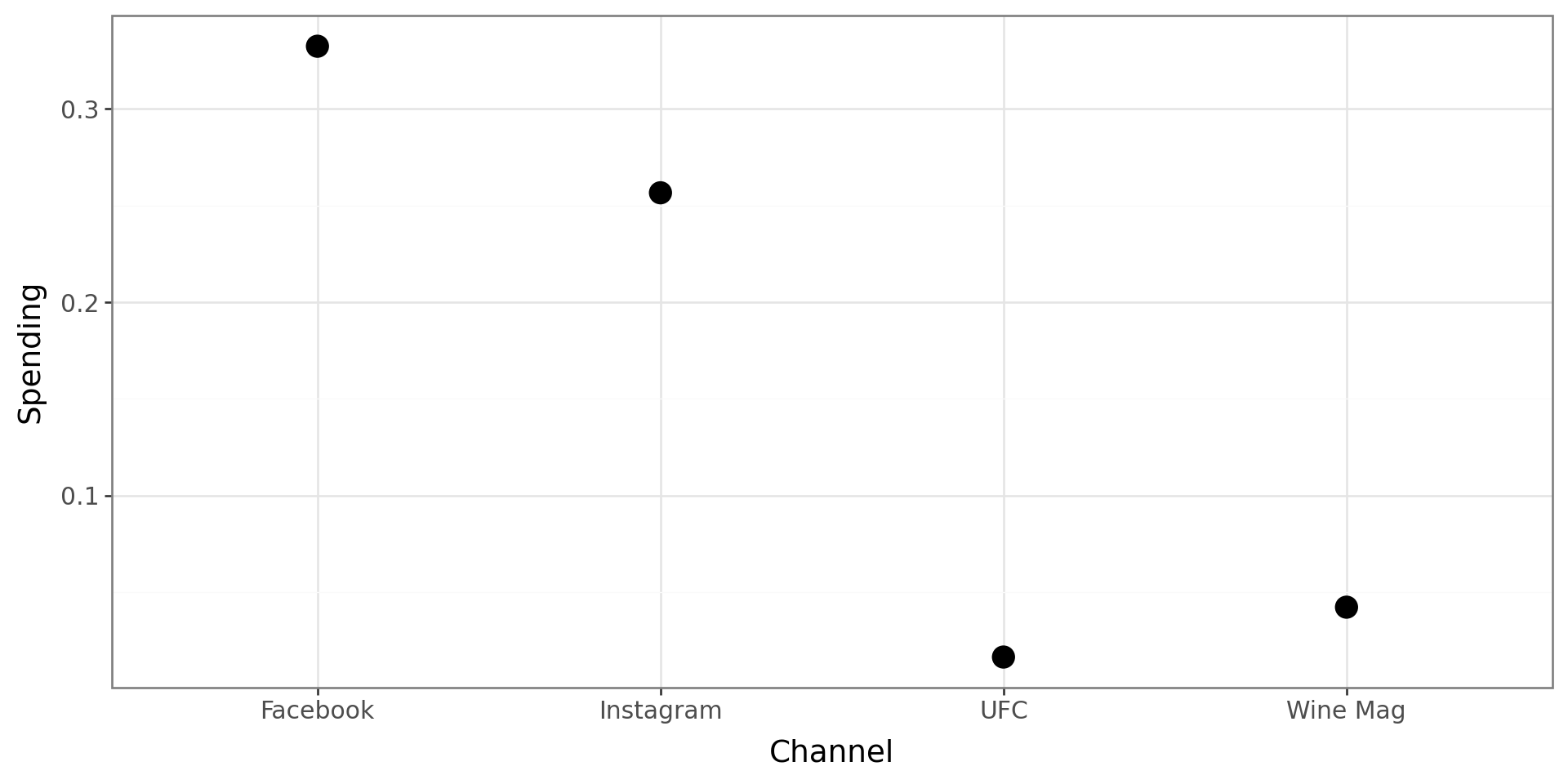
- Suppose \(\mathbf{v}_{dem}\) is uniform
Marketing Budget
- Suppose \(\mathbf{v}_{dem}\) is uniform
Marketing Budget
- Suppose \(\mathbf{v}_{dem}\) is uniform
Marketing Budget
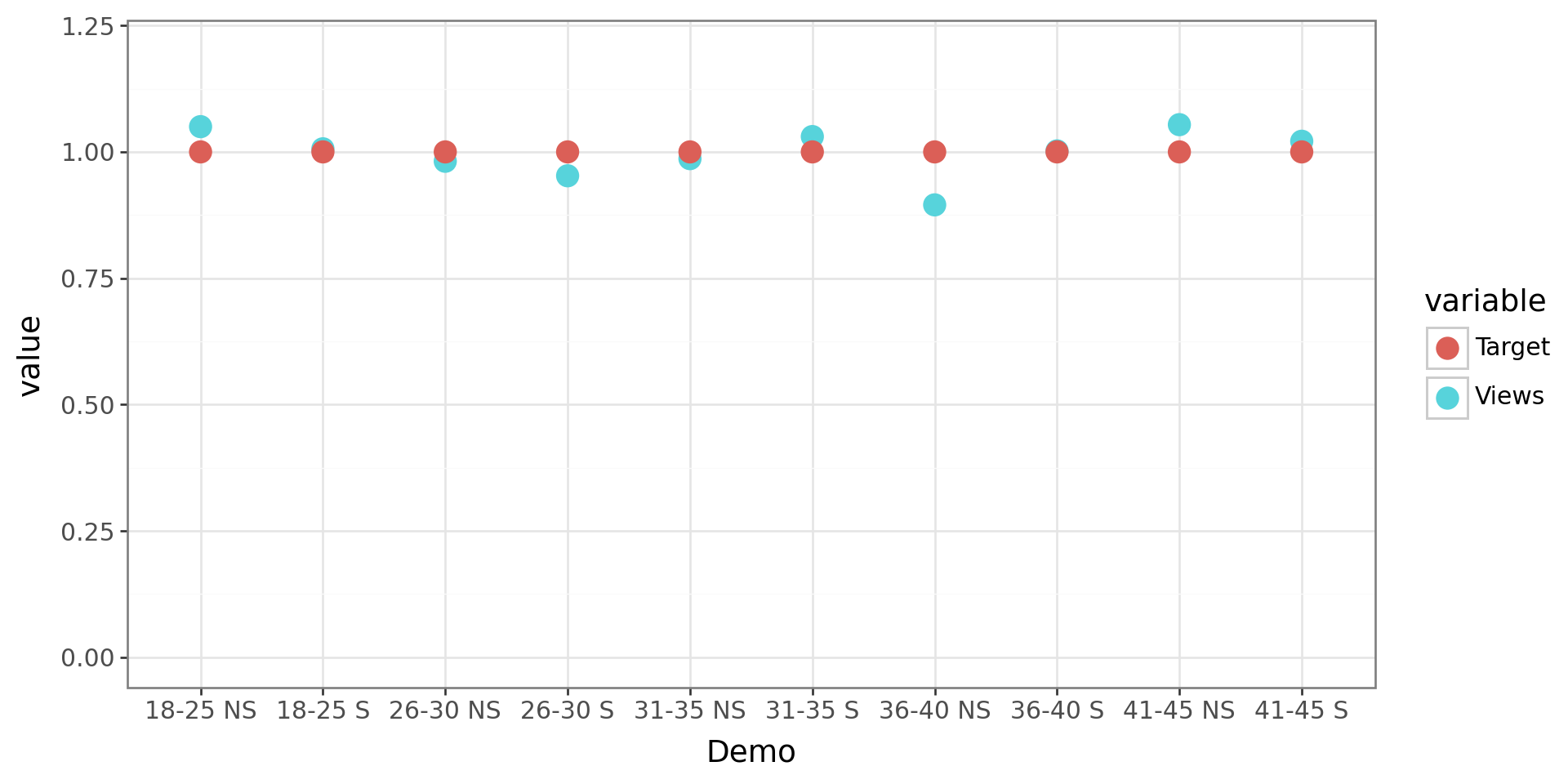
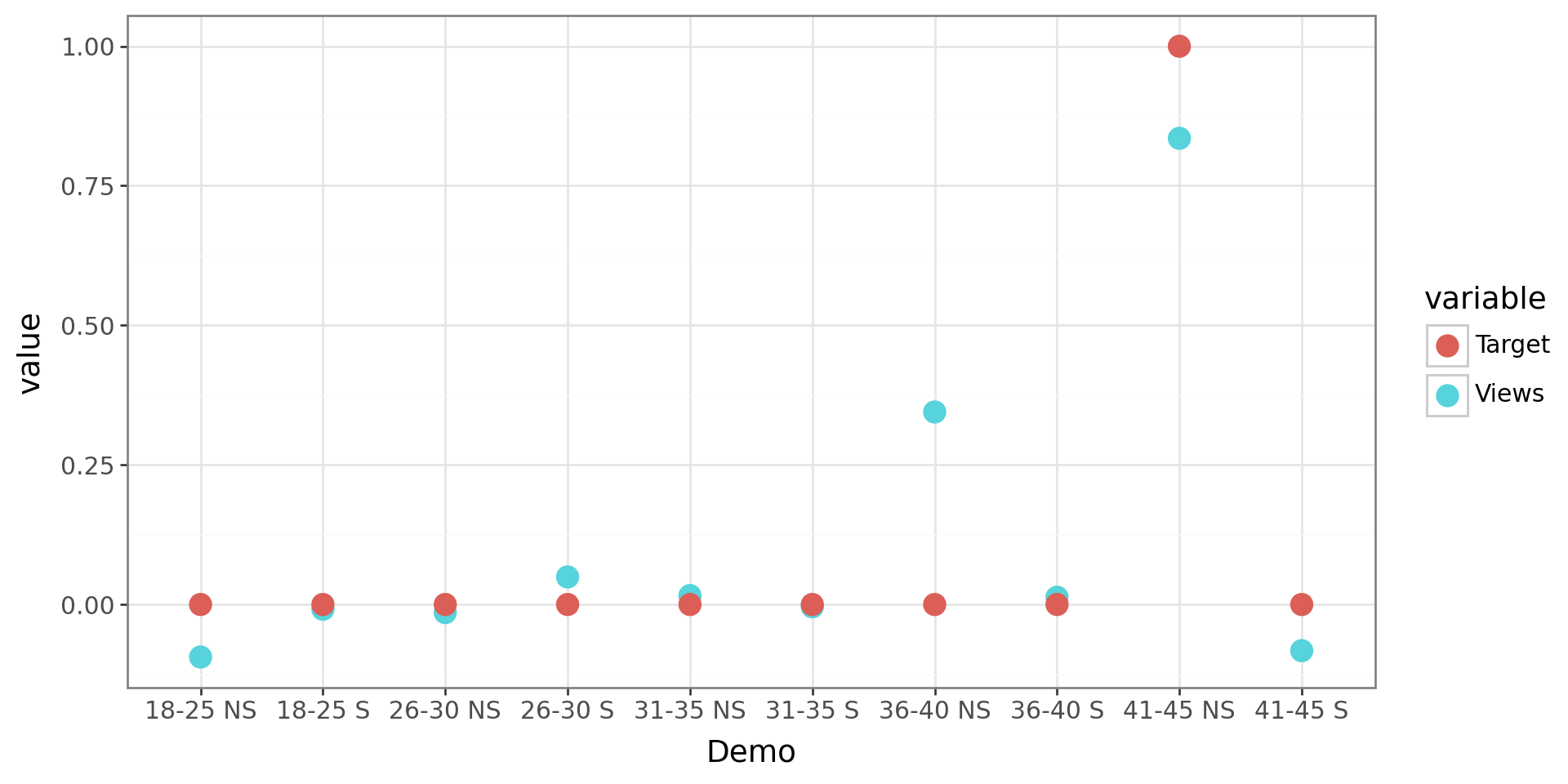
- Suppose we want to target only 41-45 Non-Sports Players
Marketing Budget
- Suppose we want to target only 41-45 Non-Sports Players
Marketing Budget Issues
- Need Constraints
- No negative money in adds: \(\mathbf{s} \geq 0\)
- No infinite budget: \(\sum_{i}s_i \leq s_{max}\)
- Need a better objective function
- Weird to target precise \(\mathbf{v}_{dem}\)
- Better to have different value for each ad impression
Network Tomography
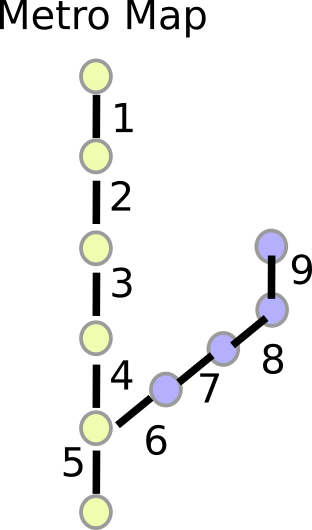
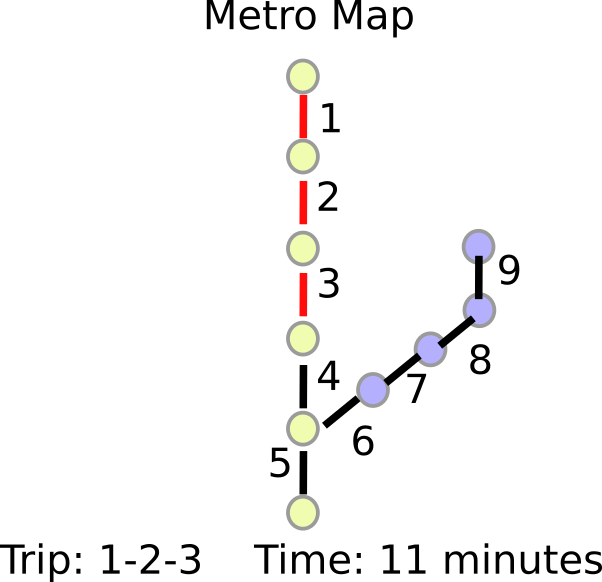
- Urban Transit
- Internet
- Know when people enter and leave
- Know path they took
- How long does it take to cross each link?
Network Tomography
Network Tomography
Network Tomography
Network Tomography
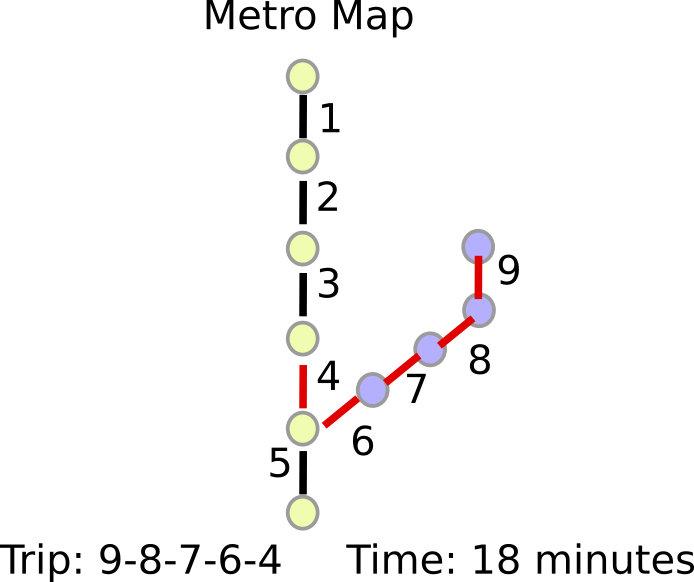
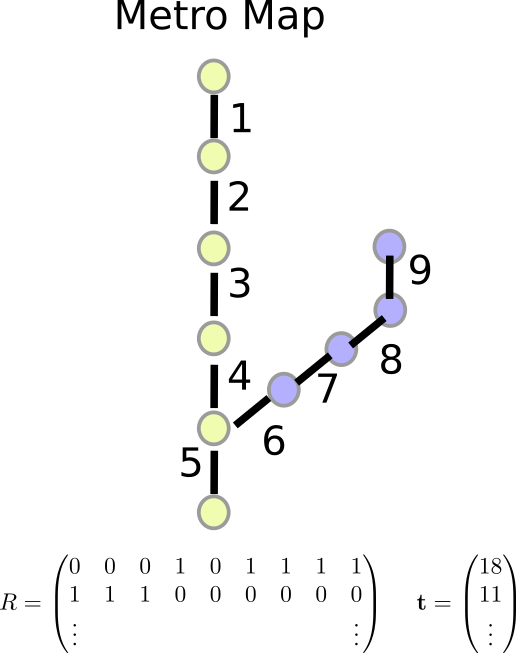
- For trip \(j\) vector \(\mathbf{r}_j\)
- \(r_{ij} = 1\) if \(i\)th “link” traversed on \(j\)th trip
- \(r_{ij} = 0\) otherwise
- Matrix \(R\) contains \(r_{ij}\)
- For \(t_j\) is the time taken on trip \(j\)
- Decision variables \(d_i\) is the time taken on the \(i\)th link
- Time is \(\sum r_{ij}d_i\)
Network Tomography
- Minimize Least Squares Error:
\[ \textrm{Find:}\quad \min_{\mathbf{d}} \|R\mathbf{d} - \mathbf{t}\|^2 \]
- Many similar problems in optimization theory
- This one is the simplest
Numerical Issues With Least Squares
Suppose you need to solve a system of linear equations: \[ A\mathbf{x} = \mathbf{b} \]
Which of these is better?
np.linalg.inv(A) @ bnp.linalg.solve(A, b)
Matrix Inverses
- Consider Singular Value Decomposition of \(A\): \[ A = U\Sigma V^T \]
- \(U\) and \(V\) are orthonormal matrices
- \(\Sigma\) contains the singular values \[ \Sigma = \begin{bmatrix} \sigma_{1} & & \\ & \ddots & \\ & & \sigma_{n} \end{bmatrix} \]
Condition Number and Accuracy
- Accuracy of
np.linalg.inv(A) @ brelated to \(\frac{\sigma_{max}}{\sigma_{min}}\) - This is called the “condition number” of the matrix \(A\)
%timeit np.linalg.inv(A) @ b
%timeit np.linalg.solve(A,b)

x1 = np.linalg.inv(A) @ b
x2 = np.linalg.solve(A,b)

print("Matrix Inverse Error: ",np.linalg.norm(A @ x1 - b))
print("Linear Solve Error: ",np.linalg.norm(A @ x2 - b))
9.53 ms ± 221 µs per loop (mean ± std. dev. of 7 runs, 100 loops each)
3.88 ms ± 145 µs per loop (mean ± std. dev. of 7 runs, 100 loops each)
Matrix Inverse Error: 3.5779616532758777e-07
Linear Solve Error: 2.8776714899819112e-15- 100 million times more accurate, 5 times faster
Issue is worse for \(A^TA\)
- What about \((A^TA)^{-1}\)?
- Let’s look at SVD: \[ A^TA = V \Sigma^T\Sigma U^T\] \[ \Sigma^T\Sigma = \begin{bmatrix} \sigma_{1}^2 & & \\ & \ddots & \\ & & \sigma_{n}^2 \end{bmatrix} \]
- Condition number problems 💀 💀 💀 💀
Do Ill-Conditioned Matrices Occur?
- Very Common
- Collinear predictors in linear regression
- Main issue in Deep Learning
- Noisy Inverse Problems
- Some of the solutions are basically just regularization
Alternatives
- Software packages generally have routines to solve least squares without computing ill-conditioned matrix inverse
- Good example is \(A = QR\) factorization
- Here \(Q\) is orthogonal and \(R\) is upper triangular
- Then \[ A^+ = (A^TA)^{-1}A^T = R^{-1} Q \]
- In practice
np.linalg.linsolve(R,Q @ b)
What if \(A\) is really big?
- Constructing \(A^TA\) costs \(mn^2\) operations
- Solving \(A^TA\mathbf{x} = A^T\mathbf{b}\) costs \(n^3\) operations
- \(A^TA\) could be a TB or larger…..
- Solution 1- variety of iterative methods (HW)
- Solution 2- Randomized Algorithms (Random Kaczmarz)
Thanks!

DATA 609