import cvxpy as cp
n = 20
m = 1000
theta = cp.Variable((n,1)) # coefficients
c0 = cp.Variable() # offset
loss = cp.sum(cp.pos(1 - cp.multiply(Y, X @ theta - c0))) # u and v
reg = cp.norm(theta, 1) # width
lambd = cp.Parameter(nonneg=True) # tradeoff
prob = cp.Problem(cp.Minimize(loss/m + lambd*reg)) #DATA 609 Meetup 11: Application to Statistics and Machine Learning
George I. Hagstrom
Week Summary
- Spring Break Next week
- HW Due in the week after spring break
- Reading: 7.1, 7.2, 8.6
- I’ll read your proposals and give some quick feedback
NY Open Statistical Computing Meetup
- April 8th 6:30-8:30+
- Great Networking/Learning Opportunity
Parametric Statistics
- Parametric statistical models assume data generated by a probability distribution that depends on parameters
- Linear regression: \[ y_i| \sim \mathrm{Normal}(\theta^T\mathbf{x}_i + y_0,\sigma) \]
- Here the parameters are \(\theta\), \(y_0\), and \(\sigma\)
Maximum Likelihood
- Likelihood is probability of observations given model coefficients \[ p(\mathbf{y}|\theta,\mathbf{x}) = \prod_{i=1}^n p(y_i|\theta,\mathbf{x}_i) \]
- Usually work with \(l(\mathbf{y},\mathbf{\theta}) = \log(p(\mathbf{y}|\theta,\mathbf{x}))\): \[ l(\mathbf{y},\theta) = \sum_{i=1}^n \log(p(y_i|\theta,\mathbf{x}_i)) \]
Maximum Likelihood
- If \(p\) is a
log-concavein \(\theta\) for fixed \(\mathbf{y}\), \(\mathbf{x}\), maximum likelihood is a convex optimization problem:
\[ \mathrm{min}_{\theta}\, -\sum_{i=1}^n \log(p(y_i|\theta,\mathbf{x}_i)) \]
- If \(p\) is a
log-concavefunction of \(\theta\), MLE problem is convex
Link to Penalty Functions
Last lecture: \[ \min_{\theta} \sum_{i=1}^n \phi(x,\theta) \]
Here \(\phi(\theta) = \log(p(y_i|\theta,\mathbf{x}_i))\)
Each penalty corresponds to a probability model \[ p(x|\theta) = \frac{e^{-\phi(x,\theta)}}{\int dx' e^{-\phi(x',\theta)}} \]
Probability and Penalty
- Squared Residuals corresponds to Gaussian Noise
- \(p(y) = \frac{e^{-y^2/(2\sigma^2)}}{\sqrt{2\pi\sigma^2}}\)
- Sum of absolute value of residuals (\(L_1\)) corresponds to Laplace noise:
- \(p(y) = \frac{e^{-|y|/a}}{2a}\)
Convexity of MLE
- For Gaussian: \[ -l(\theta) = \left(\frac{n}{2}\right)\log(2\pi\sigma^2) + \frac{\| \theta^T X -\mathbf{y}\|^2}{2\sigma^2} \]
- Not convex except if \(\sigma\) fixed
- If \(\theta\) is fixed is convex in \(1/\sigma^2\)
- Can generalize to covariance estimation
Covariance Estimation
- Hard example in 7.1
- Have many \(\mathbf{x}_i\) of variables, want to estimate covariance under a normal model \[ -l(\Sigma) = \frac{N}{2}\log(\mathrm{det}\Sigma) + \frac{1}{2}\sum_{i=1}^N \mathbf{x}_i^T\Sigma^{-1}\mathbf{x}_i \]
- Only convex in variable \(S = \Sigma^{-1}\)
Prior Knowledge
- Can incorporate constraints on parameters as a type of prior knowledge
- For example, if the parameters had been previously estimated to within a given accuracy
- For example, trying to learn if a coin is fair or not, \(p_1\) is probability of heads
- \(p_1 \sim \mathrm{Beta}(5,5)\)
- You think coin might not be fair
MAP Estimation
- Can take prior idea even further and start with a Bayesian model
- Observations \(y\) and model parameters \(\theta\)
- \(p(\theta|y)\) is probability of parameters \(\theta\) given observations \(y\)
- Probability model: \(p(y|\theta)\)
- Also have prior beliefs \(p(\theta)\)
- Bayes Theorem: \[ p(x|y) = \frac{p(y|\theta)p(\theta)}{p(y)} \]
MAP Estimation
- Harder problem: Calculate samples of posterior \(p(\theta|y)\)
- Simpler problem: Find value of \(\theta\) that maximimizes \(p(\theta,y)\)
- Maximum a-Posteriori Probability: \[ \mathrm{max}_{\theta}\, p(y|\theta)p(\theta) \]
MAP Estimation
- Can take
log\[ \mathrm{max}_{\theta}\,\, \log\left(p(y|\theta)\right) +\log\left(p(\theta)\right) \] - If \(p(y|\theta)\) and \(p(\theta)\) are log-concave, can solve
- Equivalent to maximum likelihood if prior is flat
- Prior looks like a regularization term
Non-Parametric Discrete
- Consider an unknown probability distribution \(p_i\) over random variable \(X\) with values \(x_i\)
- Observable/Feature is a function \(f\) of \(x_i\)
- \(Ef(X) = \sum_i f(x_i)p_i\) describes a convex set
- Mean, Variance, probability greater than a threshold
Entropy
- Entropy of a distribution/RV is defined as: \[ H(X) = E(-\log(p(x))) = \sum_i -p_i\log(p_i) \]
- Convex in \(p_i\)s
- Entropy stands for the amount of uncertainty contained in the random variable \(X\)
Maximum Entropy
- Suppose you have some measurements/knowledge about a random variable \(X\)
- Could be from expected values of observables
- \(Ef_k(X) = y_k\)
- Maximum Entropy probability distribution:
\[ \mathrm{min}_{p_i} \sum_i p_i\log(p_i) \\ \sum_{i} f_k(x_i)p_i = y_k \]
Maximum Entropy in Practice
- Enormously useful modeling framework
- Application uses ideas from convex optimization
- Converts from measurements to prediction while adding least additional information \[ p(x) = \exp\left(\sum_{i} \lambda_i f_i(x)\right) \\ \mathrm{min}_{\lambda} -\sum_i a_i \lambda_i + \int dx p(x|\lambda) \]
KL Divergence
Suppose you have two probability distributions \(p\) and \(q\)
The “surprise” we experience when we use \(q\) as a model for a process driven by \(p\) is given by the KL-Divergence: \[ DL(p||q) = \sum_i p_i \log(p_i/q_i) \]
Common tool used for model comparison
- Imagine \(p_i\) is true distribution
Convex loss function used in machine learning
Classification
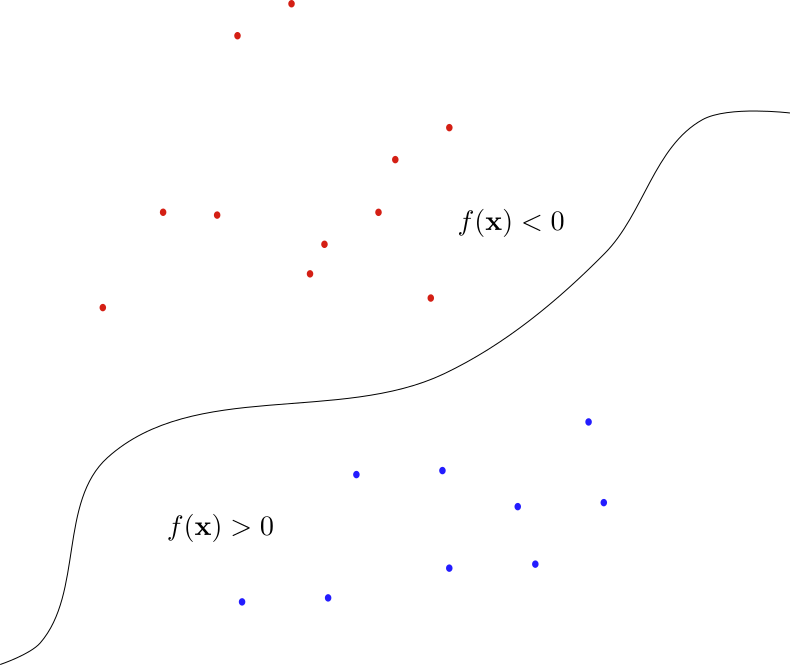
- Have two sets of points \(A = \{\mathbf{x}_{a1}, \mathbf{x}_{a2}, \mathbf{x}_{a3}, \dots\}\) and \(B = \{\mathbf{x}_{b1}, \mathbf{x}_{b2}, \mathbf{x}_{b3}, \dots\}\)
- Want to find a function \(f:\mathbb{R}^n\to\mathbb{R}\) that satisfies: \[ f(\mathbf{x}) < 0\,\, \mathrm{if}\,\, \mathbf{x} \in A \\ f(\mathbf{x}) > 0\,\, \mathrm{if}\,\, \mathbf{x} \in B \]
Classification
- Such an \(f\) classifies or discriminates the points of \(A\) and \(B\)
Classification
- To solve classification problem you need a hypothesis set \(\mathcal{H}\) of functions \(f\)
- If \(\mathcal{H}\) too complex for dataset you cannot generalize
- Imagine a family of functions which you can just specify to have any values
- Leads us to consider simple families \(f\) initially
Linear Discrimination
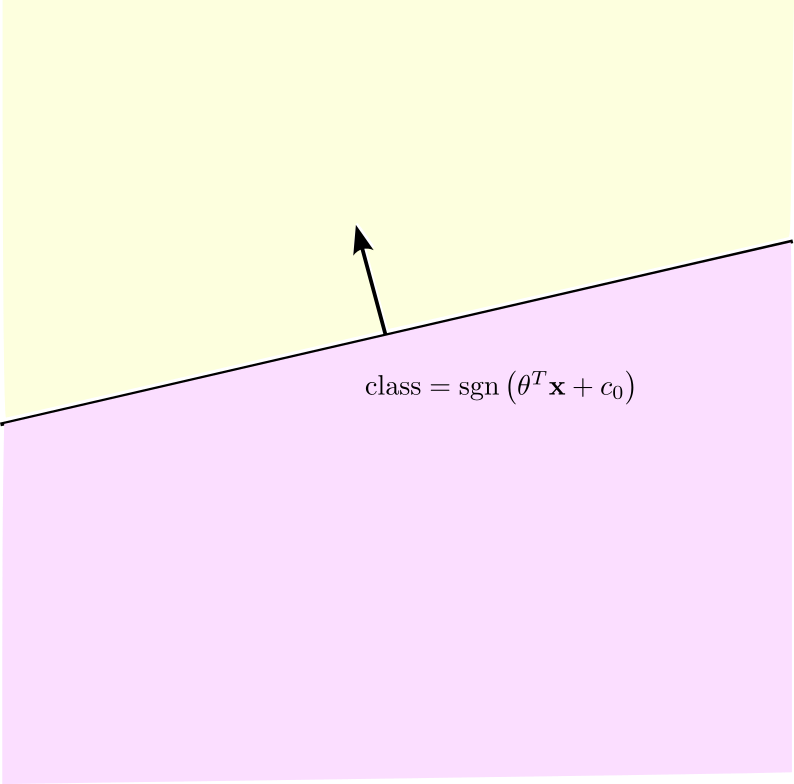
- Linear discrimination:
- \(f(\mathbf{x}) = \theta^T\mathbf{x} + c_0\)
Linear Discrimination Fails
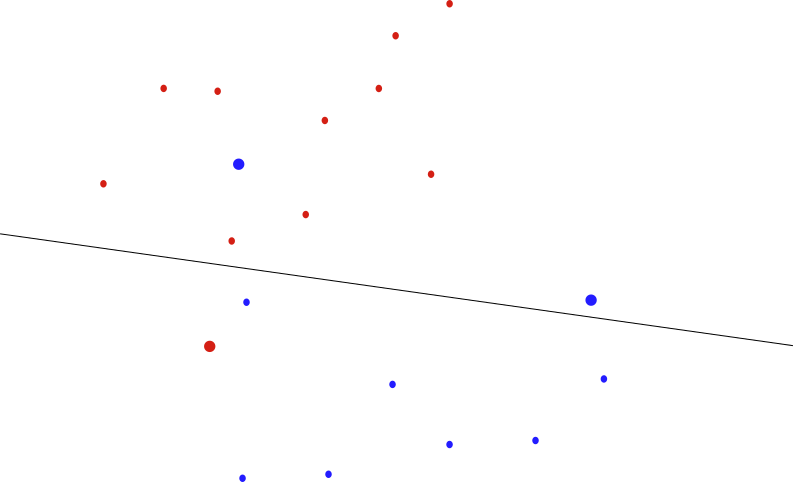
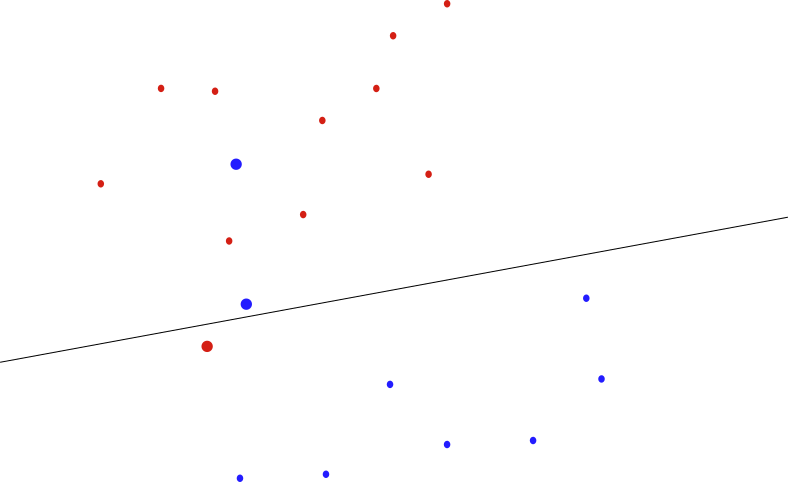
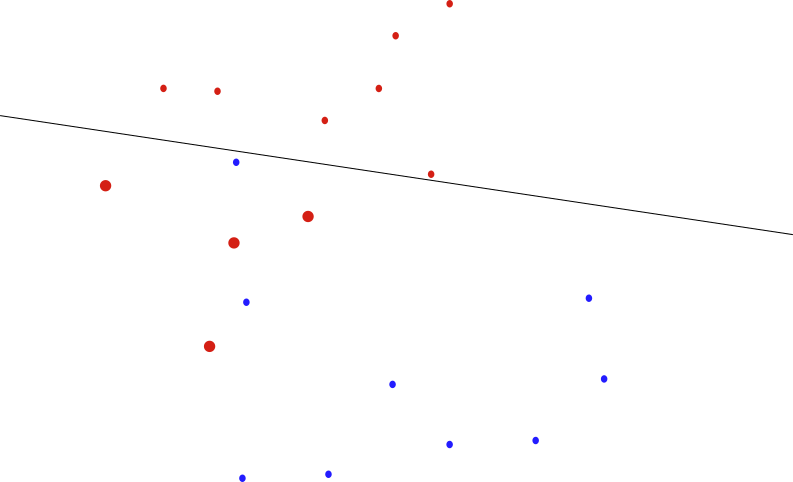
- Sets not always linearly separable
Linear Discrimination Fails
- Sets not always linearly separable
Linear Discrimination Fails
- Sets not always linearly separable
Linear Discrimination Fails
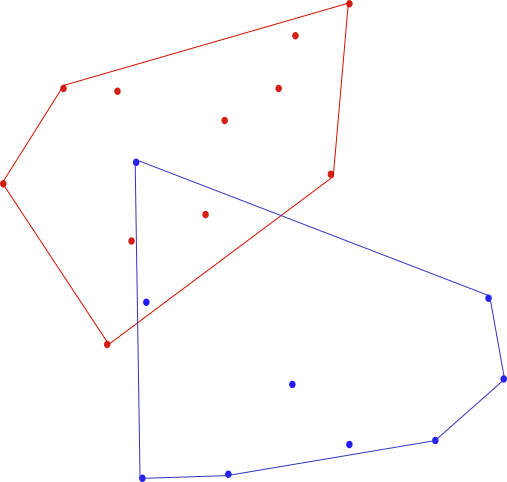
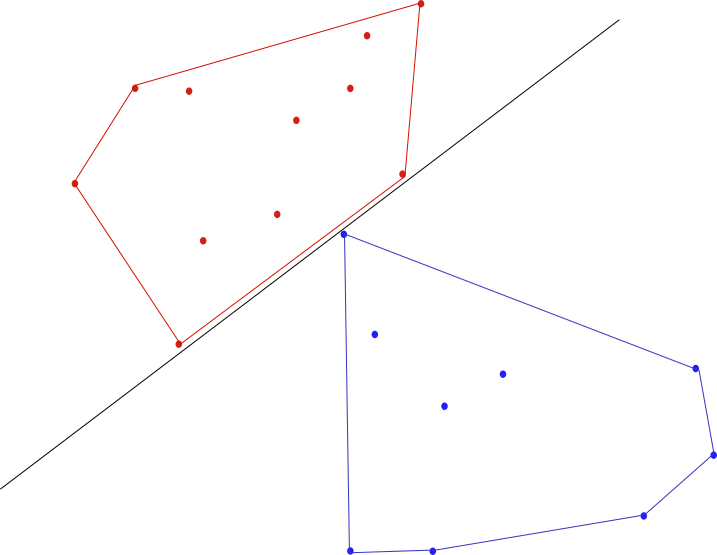
- Need Convex Hull of sets to be disjoint
Linear Discrimination Fails
- Need Convex Hull of sets to be disjoint
Support Vector Machines
- What to do if can’t separate?
- Look for approximate separation
- Minimize misclassified points directly is too hard
- Instead look to see how bad misclassifications are: \[ \theta^T\mathbf{x}_{ai} + c_0 \geq 1 - u_i \\ \theta^T\mathbf{x}_{bj} + c_0 \leq -(1-v_j) \]
- If the \(u_i\) or \(v_j\) are 0, classification successful
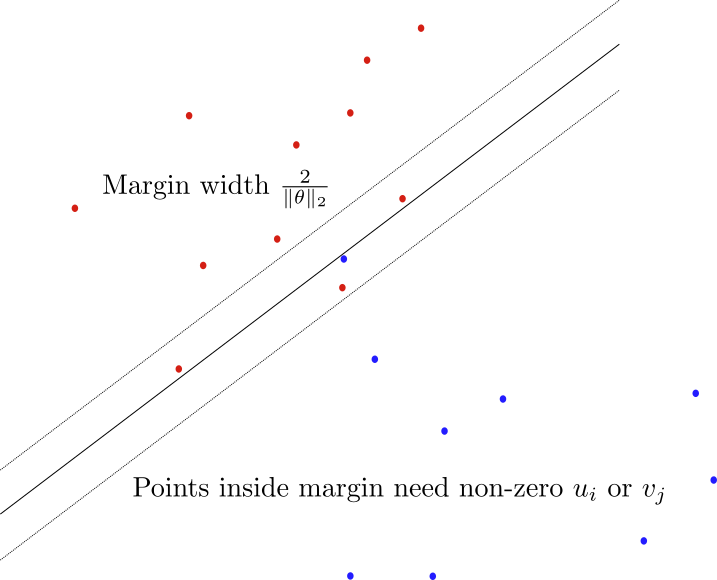
SVM Margin
- Inequalities create marginal region
- Support vectors are points inside
SVM Optimization Problem
- Maximize width of slab \(\frac{2}{\|\theta\|_2}\)
- Separates points
- Penalize misclassified points
- \(L_1\) norm of \(\mathbf{u}\) and \(\mathbf{v}\)
\[ \mathrm{min}_{\mathbf{u},\mathbf{v},\theta,c_0} \|\theta\|_2+\gamma\left(\mathbf{1}^T\mathbf{u} +\mathbf{1}^T\mathbf{v}\right) \\ \theta^T\mathbf{x}_{ai} + c_0 \geq 1 - u_i\ \\ \theta^T\mathbf{x}_{bj} + c_0 \leq -(1 - v_j)\ \\ \mathbf{u} \succeq 0\,\, \mathbf{v} \succeq 0 \]
SVM Optimization Problem
\[ \mathrm{min}_{\mathbf{u},\mathbf{v},\theta,c_0} \|\theta\|_2+\gamma\left(\mathbf{1}^T\mathbf{u} +\mathbf{1}^T\mathbf{v}\right) \\ \theta^T\mathbf{x}_{ai} + c_0 \geq 1 - u_i\ \\ \theta^T\mathbf{x}_{bj} + c_0 \leq 1 - v_j\ \\ \mathbf{u} \succeq 0\,\, \mathbf{v} \succeq 0 \]
- \(\gamma\) balances objective of slab width and misclassified points
- Affine plus norm and linear inequalities so convex
Implementation
- Reformulate a little
- Either \(u_i=0\) or \(u_i = 1-\theta^T\mathbf{x}_{ai}-c_0\)
- Either \(v_j=0\) or \(v_j = 1-\theta^T\mathbf{x}_{bj}-c_0\)
\[ \mathrm{min}_{\theta,c_0} \|\theta\|_2 + \gamma\left(\sum_i\mathrm{max}(0,1-\theta^T\mathbf{x}_{ai}-c_0) +\\ \sum_j\mathrm{max}(0,1-\theta^T\mathbf{x}_{bj}-c_0)\right) \]
Implementation
- Rescaled loss by number of points
cp.sum(cp.pos(1 - cp.multiply(Y, X @ theta - c0)))is calledhinge-loss- \(Y = \pm 1\) is the class
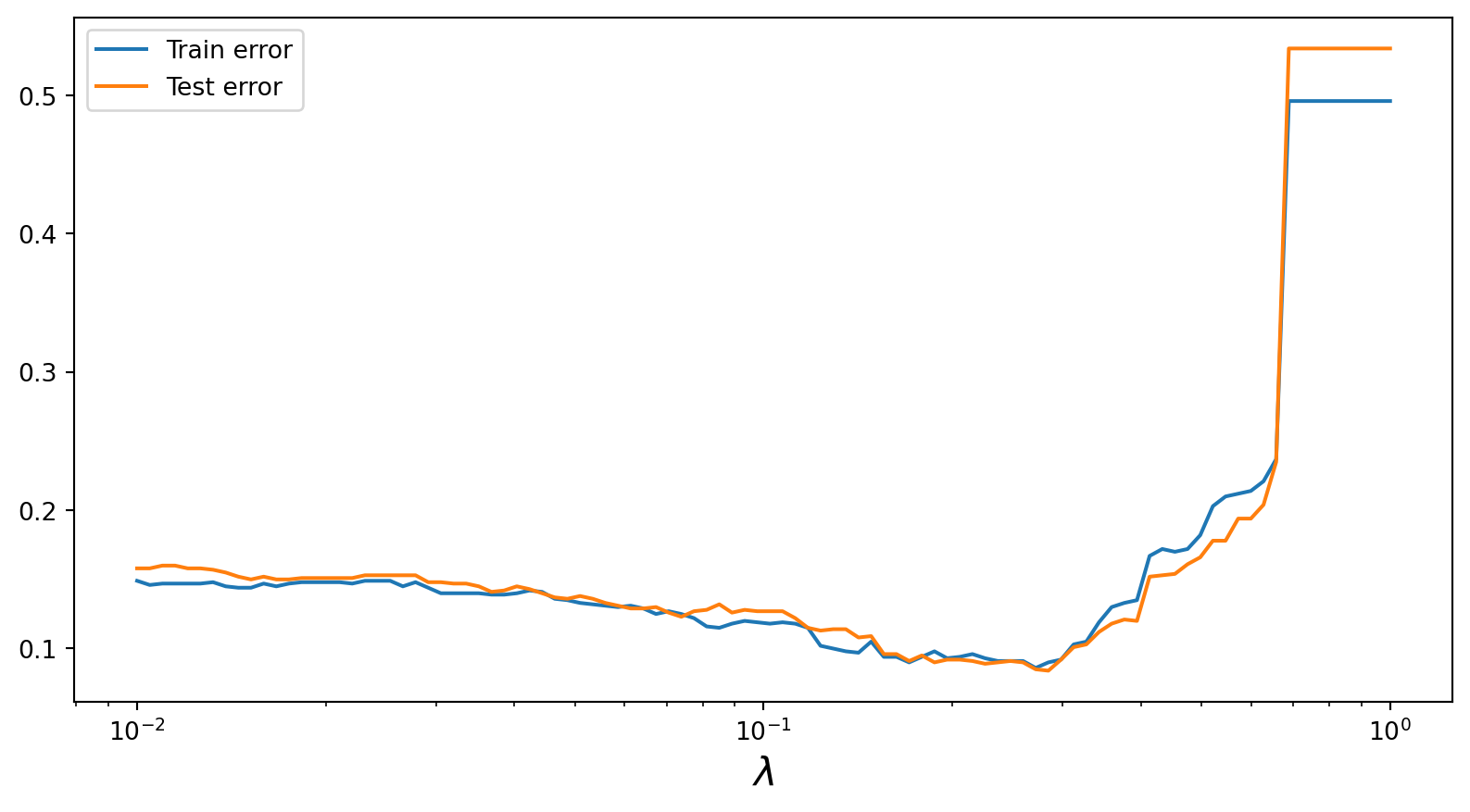
Testing Regularization
# Compute a trade-off curve and record train and test error.
TRIALS = 100
train_error = np.zeros(TRIALS)
test_error = np.zeros(TRIALS)
lambda_vals = np.logspace(-2, 0, TRIALS)
theta_vals = []
for i in range(TRIALS):
    lambd.value = lambda_vals[i]
    prob.solve()
    train_error[i] = (np.sign(X.dot(theta_true) + offset) != np.sign(X.dot(theta.value) - c0.value)).sum()/m
    test_error[i] = (np.sign(X_test.dot(theta_true) + offset) != np.sign(X_test.dot(theta.value) - c0.value)).sum()/TEST
theta_vals.append(theta.value)- Here test/train errors are percentage of points classified correctly
Train/Test Error
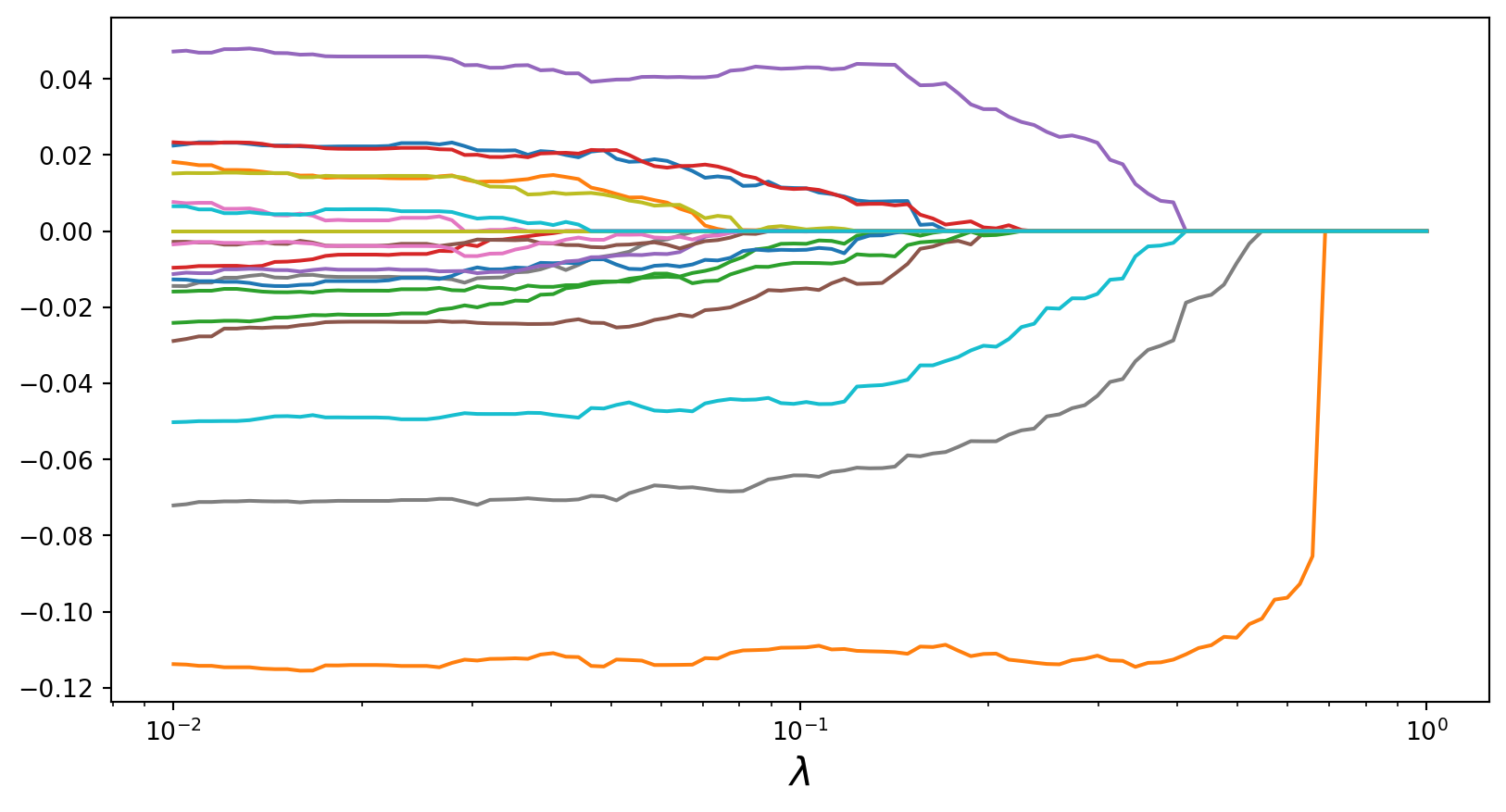
Regularization Paths
Do more with SVMs
- SVMs not restricted to linear separation
- Can use nonlinear functions to generate additional features
- Leads to higher dimensional space in which sometimes linear separator is more effective