Week Summary
- Working on grading….
- This week: definition and examples of convex functions
- Next week: How to construct convex functions
- Reading: Section 3.1,
CVX tutorials
- Lab 4 available
What is a convex function?
- Start with function \(f:\, \mathbb{R}^N\to\mathbb{R}\)
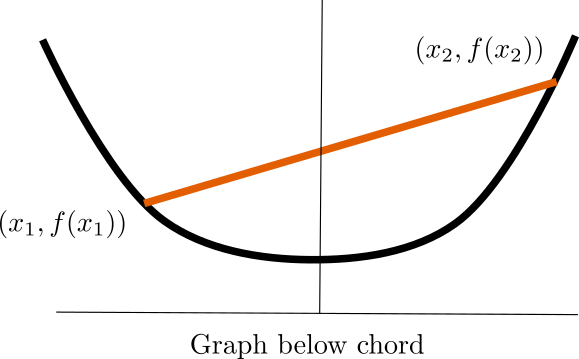
- Graph of \(f\) is below line between any two points on graph:
![]()
What is a convex function?
\[
f(\theta \mathbf{x}_1 + (1-\theta)\mathbf{x}_2) \leq \theta f(\mathbf{x}_1) + (1-\theta)f(\mathbf{x}_2)
\]
![]()
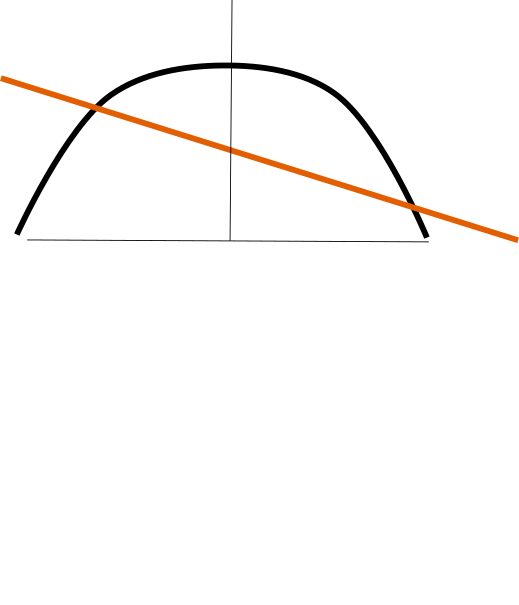
Concave
- \(f\) is concave if \(-f\) is convex
- \(f\) curves down instead of up
![]()
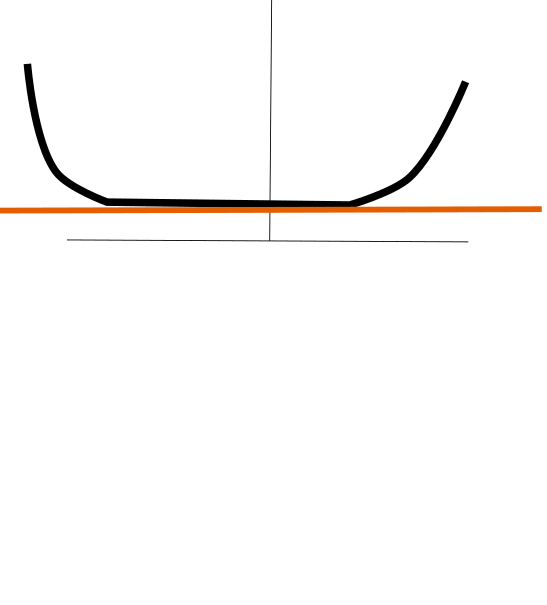
Strict Concavity
- Equalty only at endpoints, i.e. for \(\theta \neq 0, 1\): \[
f(\theta \mathbf{x}_1 + (1-\theta)\mathbf{x}_2) \leq \theta f(\mathbf{x}_1) + (1-\theta)f(\mathbf{x}_2)
\]
![Not Strictly Convex]()
Graph in Higher Dimensions
graph of a function \(f: \mathbf{dom}(f)\to\mathbb{R}\): \[G(f) = \{(\mathbf{x},f(\mathbf{x}))\,|\, \mathbf{x}\in\mathbf{dom}(f)\}\]- 1D: \((x,y=f(x))\), familiar graph
- 2D: \((x,y,z=f(x,y))\), 3D surface/landscape
- 3D+: \(\left(x_1,x_2,x_3,...,x_n,z=f(x_1,x_2,x_3,...,x_n)\right)\)
Tangent Lines
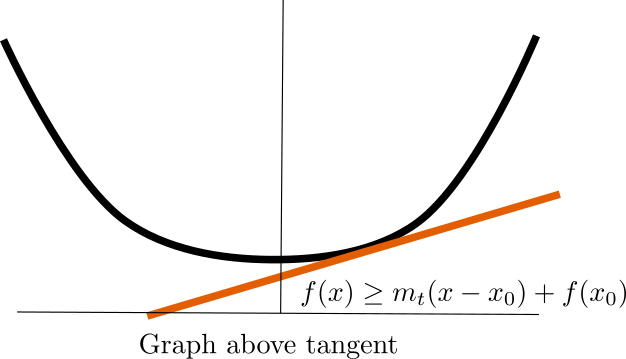
- Graph lies above tangent lines/planes/hyperplanes
![]()
Local to Global Info
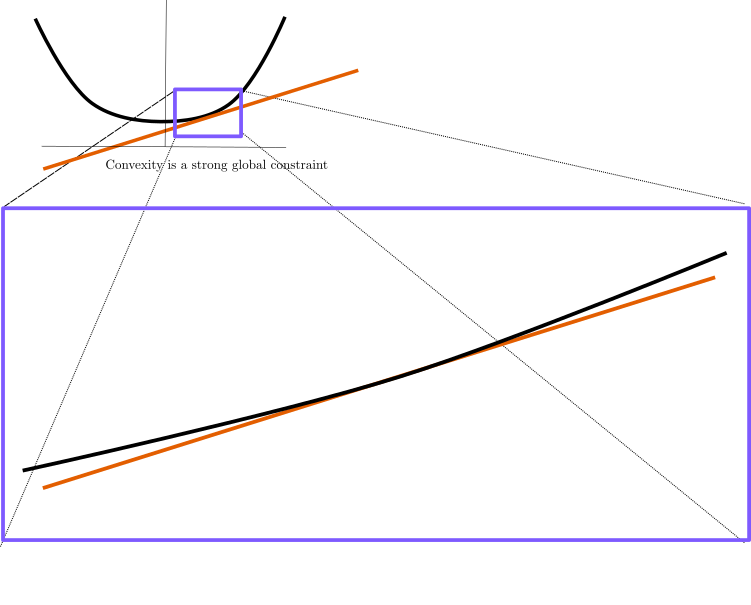
- Tangent line is a local property
![]()
Local to Global Info
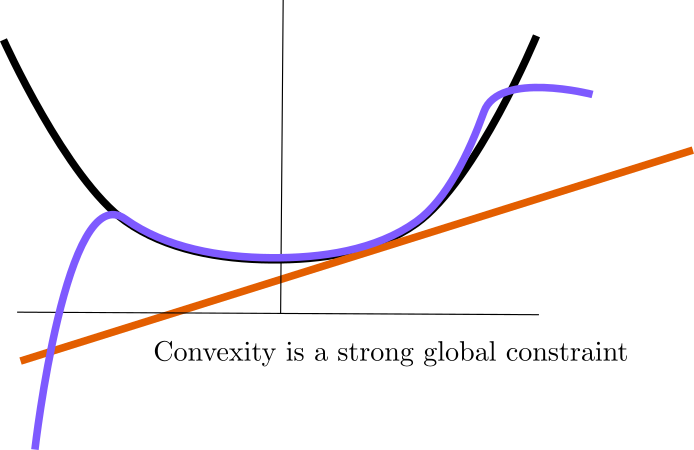
- But for Convex gives global information!
![]()
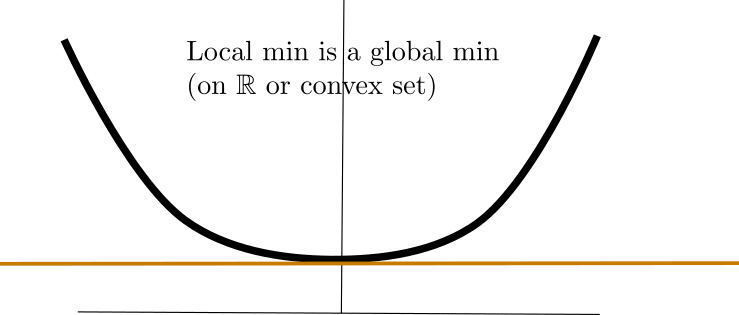
Local Min is Global Min
- Local minimum implies flat tangent
![]()
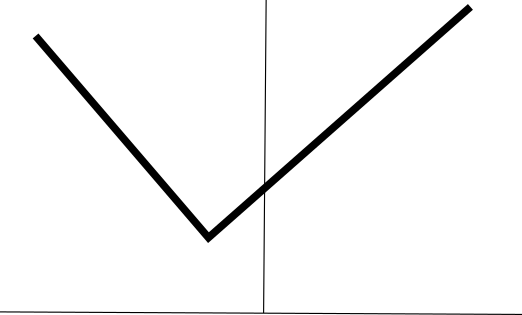
What if there is no single tangent?
![]()
- Slightly different argument is needed
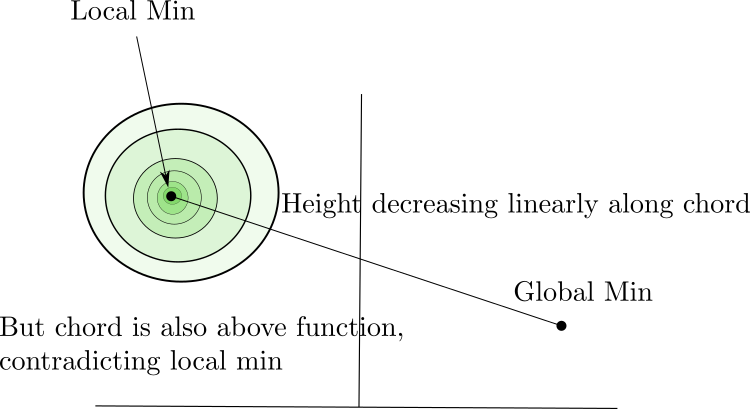
Local Min is a Global Min
- Take \(f:\,\mathbb{R}^2\to\mathbb{R}\)
- Assume there is a local min that isn’t the global min
![]()
Examples: Affine
- Affine \(f(\mathbf{x}) = \mathbf{c}^T\mathbf{x} + \mathbf{d}\)
- Both convex and concave
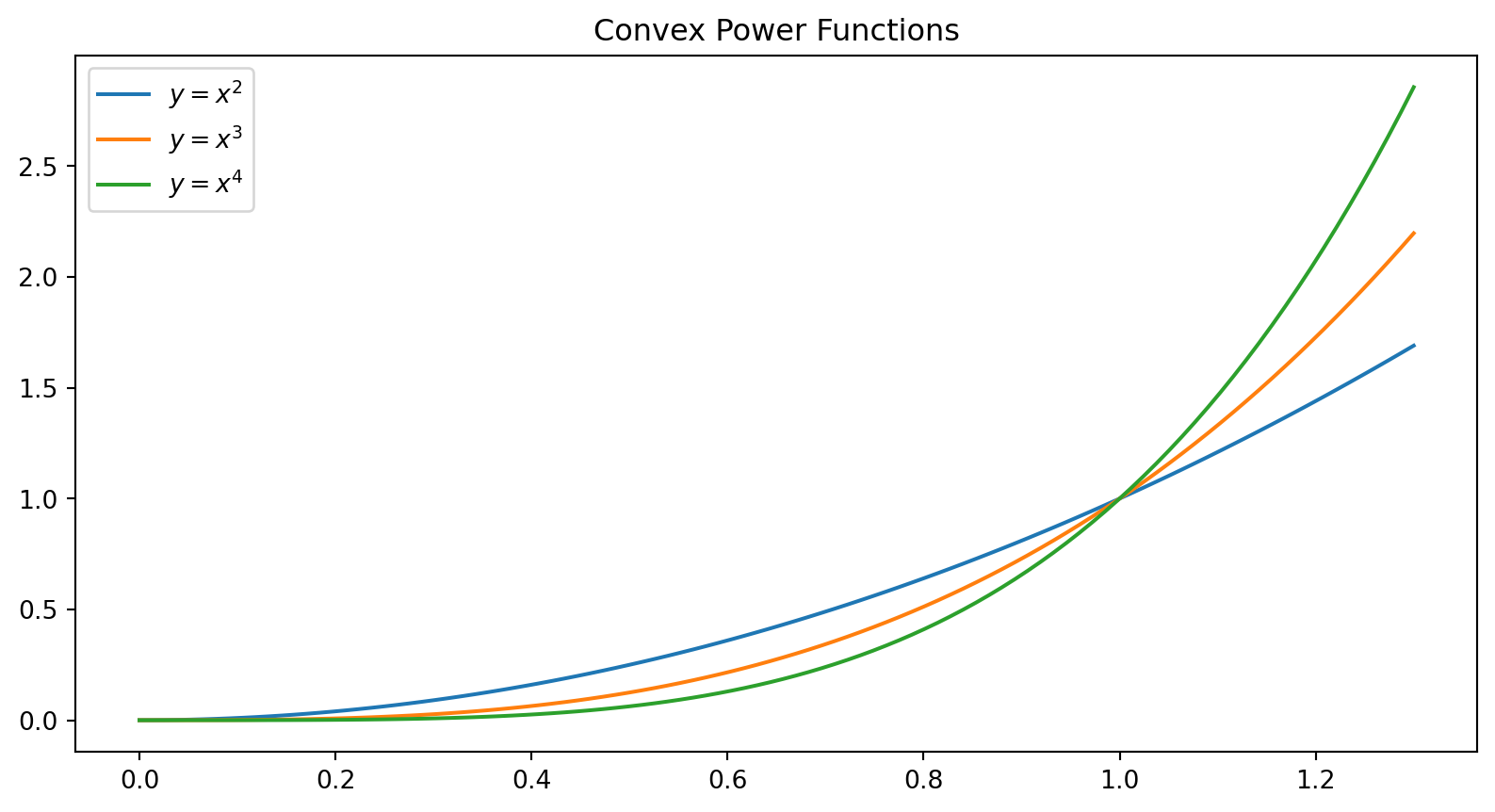
Examples: Power Functions
- Power Functions: \(f(x) = x^{\alpha}\)
- Convex for \(\alpha\geq 1\) on \(\mathbb{R}_+\)
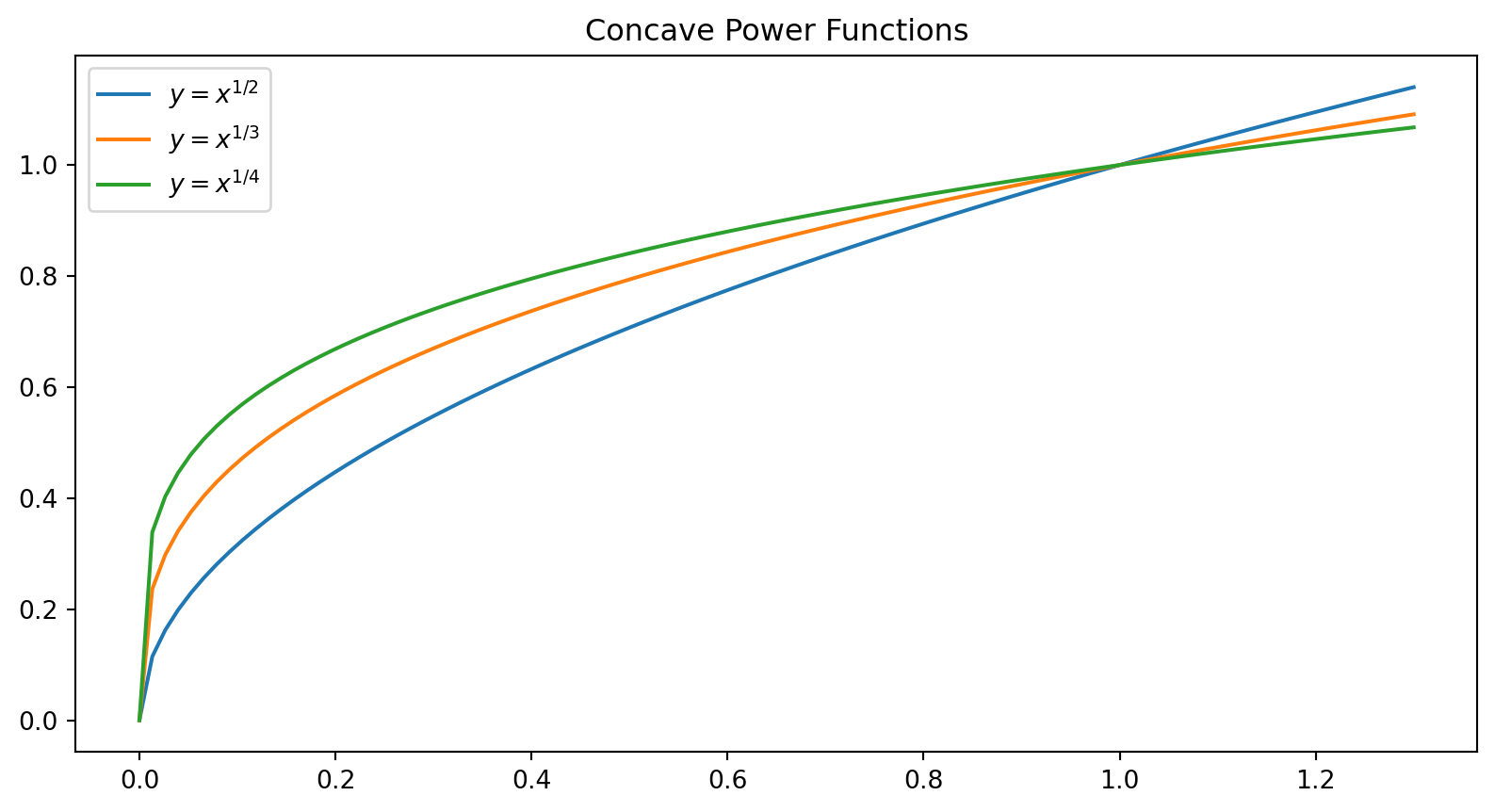
Examples: Power Functions
- Power Functions: \(f(x) = x^{\alpha}\)
- Concave for \(0<\alpha\leq 1\) on \(\mathbb{R}_+\)
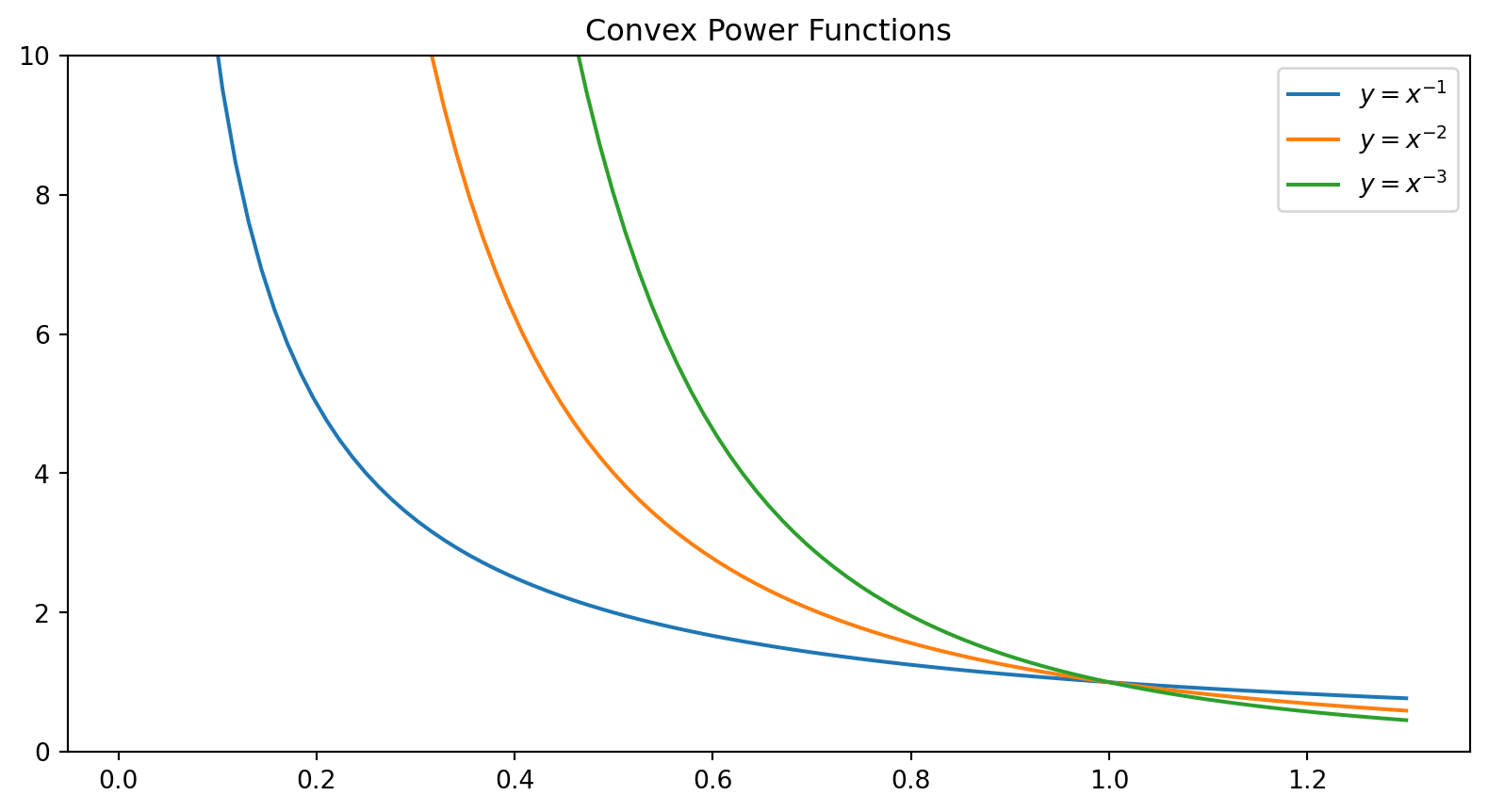
Examples: Power Functions
- Power Functions: \(f(x) = x^{\alpha}\)
- Convex for \(\alpha\leq 0\) on \(\mathbb{R}_{++}\)
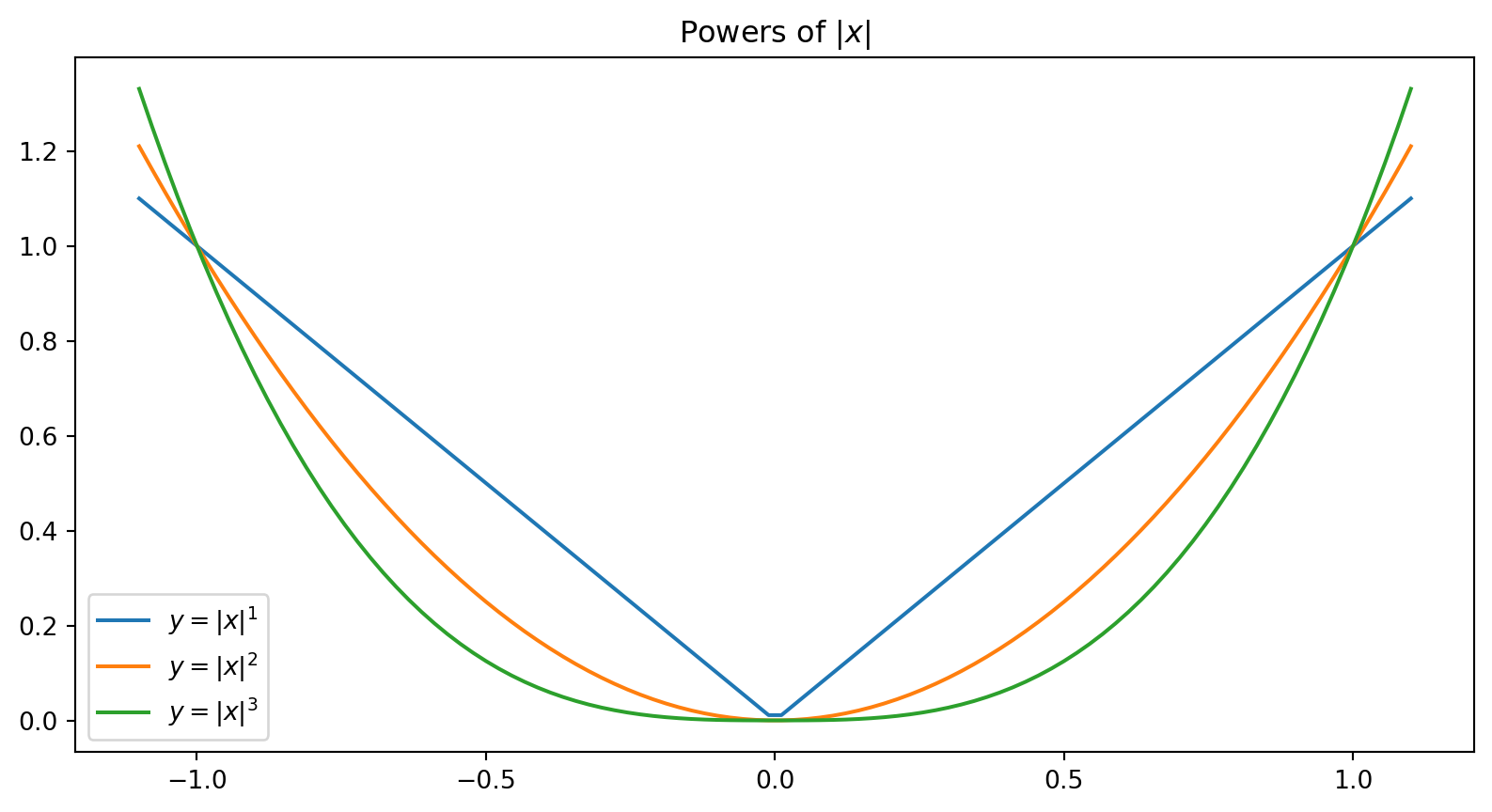
Examples: \(|x|^{\alpha}\)
- \(f(x) = |x|^{\alpha}\) is convex on \(\mathbb{R}\) for \(\alpha\geq 1\)
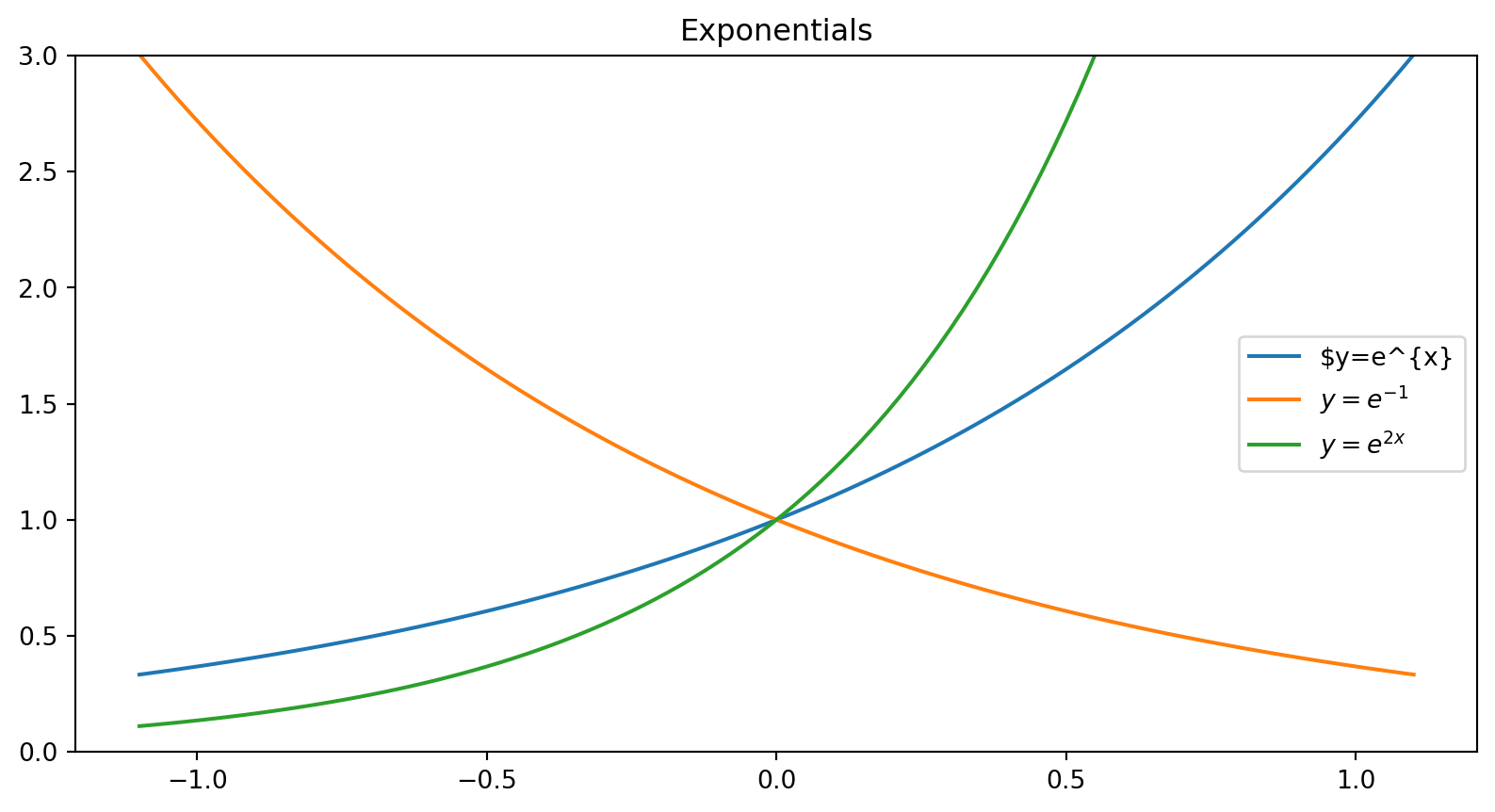
Examples: \(e^{\alpha x}\)
- \(e^{\alpha x}\) is convex for any \(\alpha\)
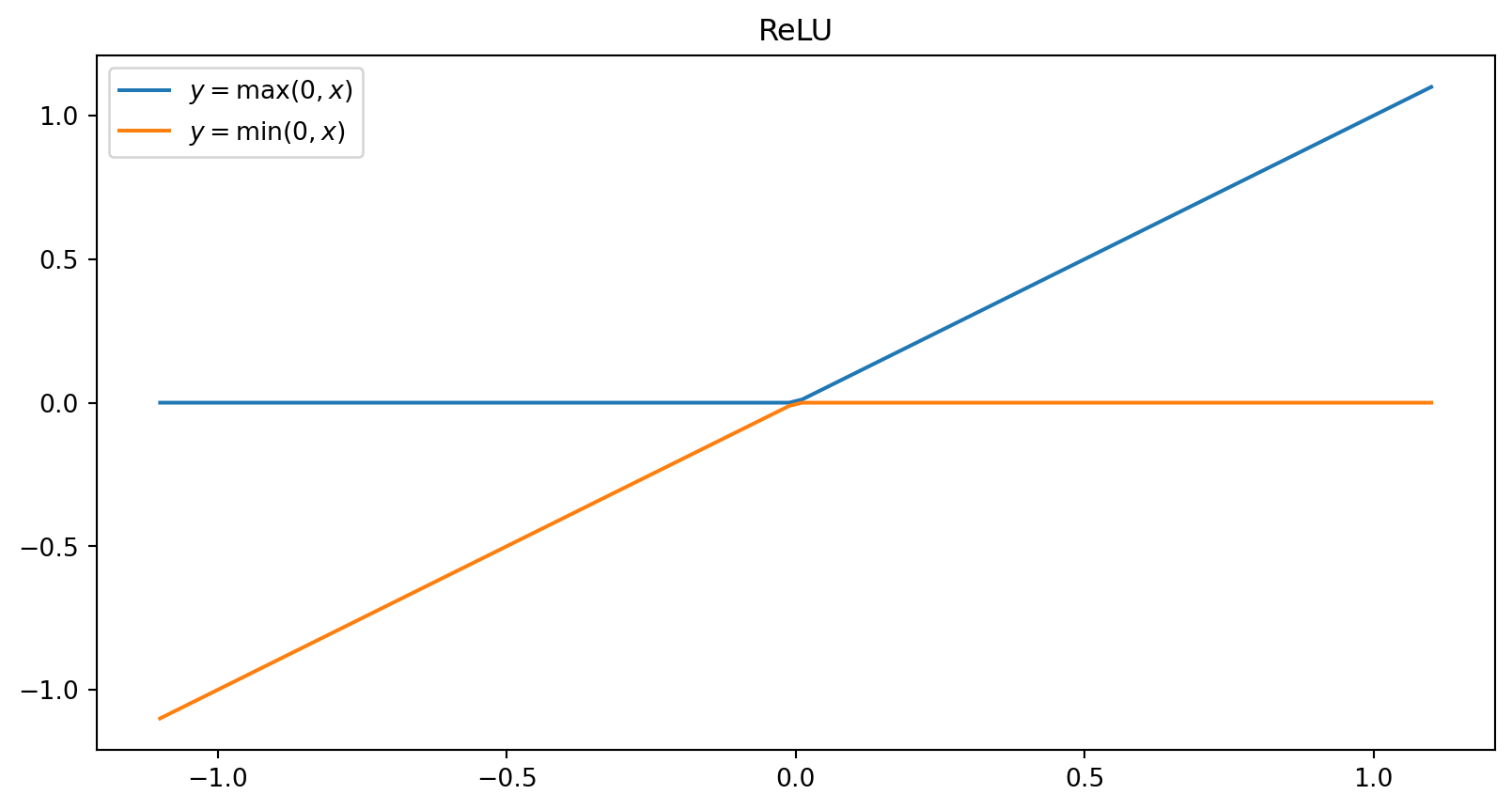
Examples: Rectified Linear Unit
- \(\max(0,x)\) is convex
- \(\min(0,x)\) is concave
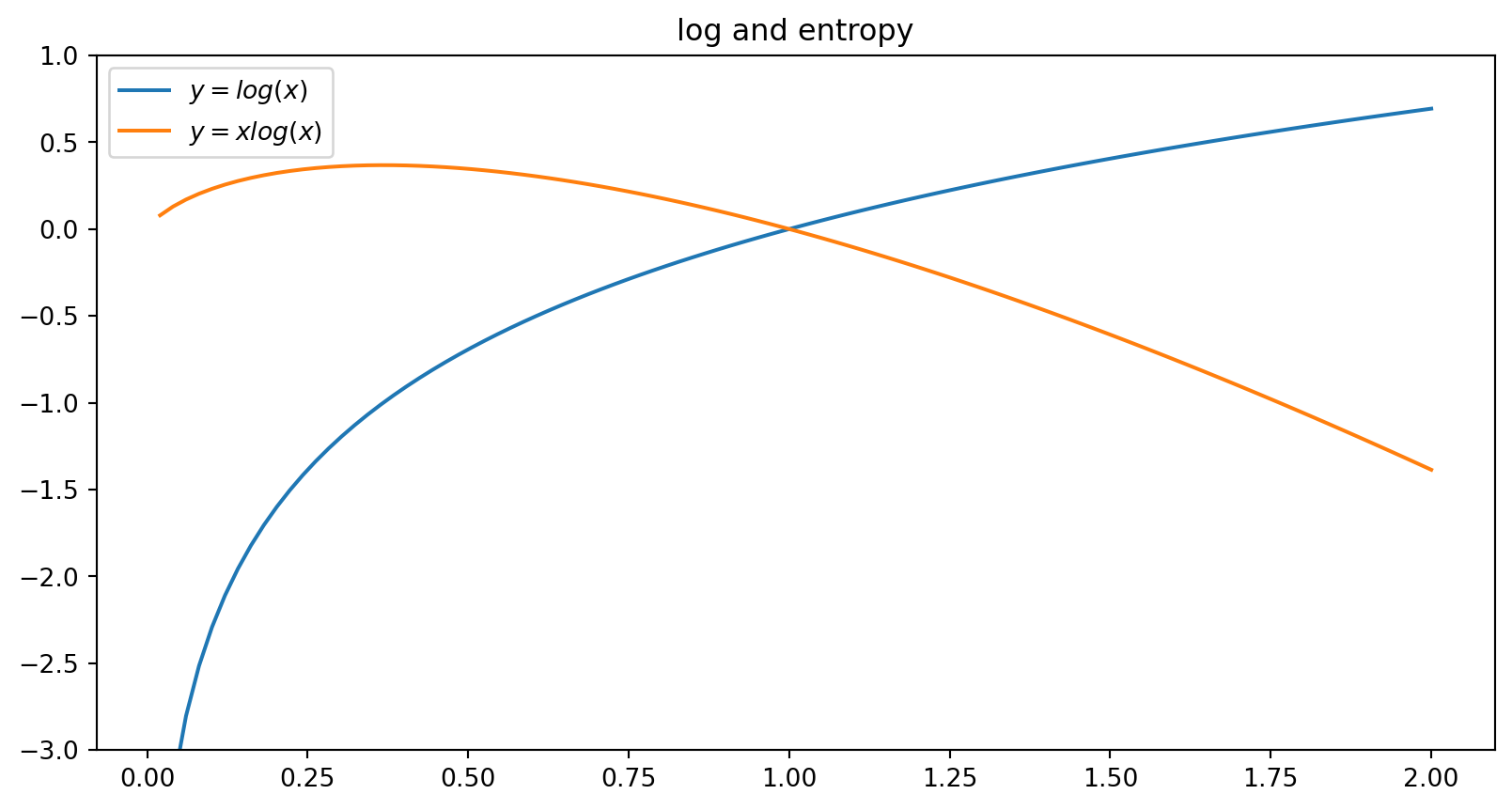
Examples: log and entropy
- \(f(x) = \log(x)\) is concave on \(\mathbb{R}_{++}\)
- \(f(x) = -x\log(x)\) is concave on \(\mathbb{R}_{+}\)
Examples: Norms
All norms are convex on \(\mathbb{R}^N\to\mathbb{R}\) \[ \|\mathbf{x}\| = \left(\sum_i x_i^2\right)^{1/2} , \|\mathbf{x}\|_p = \left(\sum_i x_i ^p\right)^{1/p} \\
\|\mathbf{x}\|_{\infty} = \max(x_1,x_2,...,x_n)
\]
Sum of squares also \(\|\mathbf{x}\|^2 = \mathbf{x}^T\mathbf{x}\)
Lasso and Sparse Regression
- Consider Least Squares Problem
\[
\min_{\mathbf{x}} \|A\mathbf{x}-\mathbf{b}\|^2
\]
- Suppose \(\mathbf{x}\) has many entries
- \(A\) could even be wide
- You only want to use a few features
- Your data may have outliers
Lasso and Sparse Regression
- Apply the following penalty:
\[
\min_{\mathbf{x}} \|A\mathbf{x}-\mathbf{b}\|^2 + \lambda \sum_i |x_i|
\]
\[
\min_{\mathbf{x}} \|A\mathbf{x}-\mathbf{b}\|^2 + \lambda\|\mathbf{x}\|_1
\]
Lasso and Sparse Regression
- We will learn that adding convex functions preserves convexity
- Lasso regularization of convex problem also convex
- Has a tendency to produce robust solutions with sparse coefficients \(\mathbf{x}\)
Softmax and Geometric Mean
- \(\log\left(\sum_{i=1}^n e^{x_i}\right)\) is convex
- This is a smoothed maximum function
- \(\left(\Pi_{i=1}^n x_i\right)^{1/n}\)
First and Second Order Conditions
- First Order Condition: \(f\) is convex if and only if graph lies above all tangent lines
- Second Order Condition: \(f\) is convex if and only if the Hessian is positive semi-definite at all points in (convex) domain \[
\left(\nabla^2{f}\right)_{ij} = \frac{\partial^2 f}{\partial x_i \partial x_j} \succeq 0
\]
Second Order Condition
- Show that \(f(x) = e^{\alpha x}\) is convex
- Take first derivative:
- \(f'(x) = \alpha e^{\alpha x}\)
- Take second derivative:
- \(f''(x) = \alpha^2 e^{\alpha x}\)
- \(f''(x) \geq 0\), so \(f\) is convex
- Also implies sum of convex is convex
Quadratic over Linear
- \(f(x,y) = \frac{x^2}{y}\), \(\mathbf{dom}(f) = \mathbb{R}\times\mathbb{R}_{++}\)
- Start taking derivatives \[
\nabla f = \begin{bmatrix} \frac{2x}{y} & -\frac{x^2}{y^2} \end{bmatrix}^T
\]
\[\nabla^2 f = \begin{bmatrix} \frac{2}{y} & -\frac{2x}{y^2} \\
-\frac{2x}{y^2} & \frac{2x^2}{y^3} \end{bmatrix}
\]
- Positive semidefinite because \(\mathrm{det}(\nabla^2 f)\geq 0\) and \(Tr(\nabla^2 f) > 0\)
Restriction to Line
- \(f:\mathbb{R}^n\to\mathbb{R}\) is convex if and only if it is convex when restricted to every single line in \(\mathbb{R}^n\)
- \(g(t) = f(\mathbf{b}+t\mathbf{v})\) is convex for all vectors \(\mathbf{v}\), \(\mathbf{b}\)
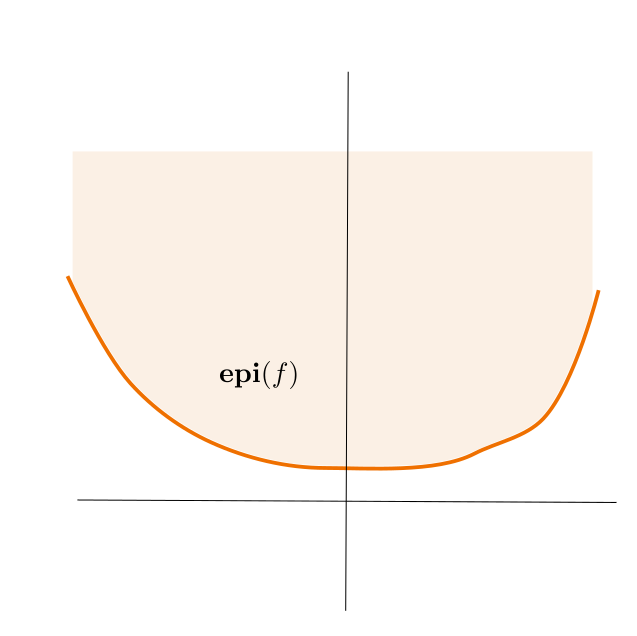
Epigraph
- \(\mathbf{epi}(f)\) is set of points above the graph of \(f\) \[
\{(\mathbf{x},z)\,| \mathbf{x}\in\mathbf{dom}(f),\, z\geq f(\mathbf{x})\}
\]
![]()
Epigraph
- \(f\) is convex if and only if \(\mathbf{epi}(f)\) is a convex set
- Allows for construction of more convex sets
- \(f\) is concave if and only if \(\mathbf{sub}(f)\) is a convex set
- This is convex: \[
\{(x,y)| \log(x) \leq y \ \leq e^{\alpha x}\}
\]
Sub/Super Level Sets
- Solution set of inequality defines sub: \[\mathbf{sub}_{\alpha}(f) = \{\mathbf{x}| f(\mathbf{x}\leq \alpha)\}\]
- Super-level set has oppositve inequality
- \(\alpha\)-sublevel sets of a convex function are convex
- \(\alpha\)-superlevel sets of a concave function are convex
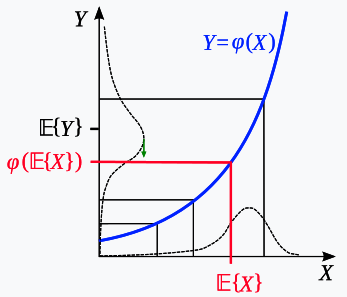
Jensen’s Inequality (Project?)
- Useful result in probability and statistics:
- If \(f\) is a convex function and \(x\) a random variable, then: \[
\mathrm{E}[f(x)]\geq f(\mathrm{E}[x])
\]
- Because expectation is \(\sum_i p_i x_i\), convex combination of values of \(x\)
Jensen’s Inequality
![]()
wikipedia
Convexity/Concavity important in life
Jensen and Fragility
- Suppose something in your life is random
- Consider your payoff function \(f(x)\)
- If your \(f\) is convex, Jensen says randomness helps you
- Your Outcome = \(\mathrm{E}[f(x)]\) better than outcome of average \(f(\mathrm{E}[x])\)
- If your payoff is concave, Jensen says randomness hurts you
Car Traffic Example
- Few cars, drive speed limit
- Cars above threshold, speed drops
- Expected Traffic is 30 cars
- Expected Time 65 minutes
| Cars | Time       |
|------|------------|
| 1    | 30 minutes |
| 10   | 30 minutes |
| 20   | 30 minutes |
| 30   | 40 minutes |
| 40   | 1 hour     |
| 50   | 1.5 hours  |
| 60   | 3 hours    |
Jensen and Fragility
- Convex payouts are called anti-fragile
- Concave payouts are called fragile
- Many times in life we don’t can’t fully quantify the risks we face
- But sometimes we can control the outcome for ourselves should something bad happen
- Moral- make your payouts convex if you can