DATA 622 Meetup 12: Neural Networks

George I. Hagstrom

2026-04-20

Week Summary

  • Contact me ASAP if you haven’t scheduled MVP demo
  • Lab 7 due Sunday May 3rd
  • You will want a Google Colab Pro student account!!!
  • Vignette on neural networks in Colab

Neural Network Gameplan

  • Week 12: Basics, pytorch, activation functions, optimization algos
  • Week 13: CNNs, RNNs, Deep Learning Considerations, vision applications
  • Week 14: Pretrained Networks, Transfer Learning, text applications

Introduction to Neural Networks

  • Invented originally to understand how the brain works
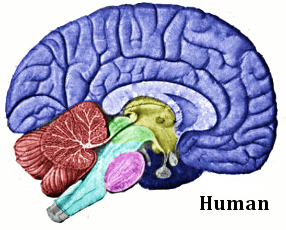
Source: wikipedia

Introduction to Neural Networks

  • Was found to have an enormous number of applications
    • Classification
    • Pattern Recognition
    • Generative Models

Introduction to Neural Networks

  • Interesting objects in their own right
    • People study them as they would any other complex systems

What is a Neuron?

  • Neurons send and receive electrical signals
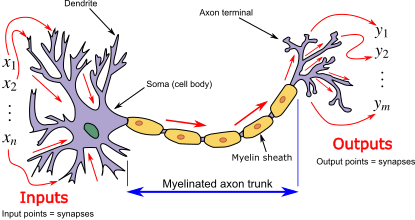
wikipedia

Connected Neurons

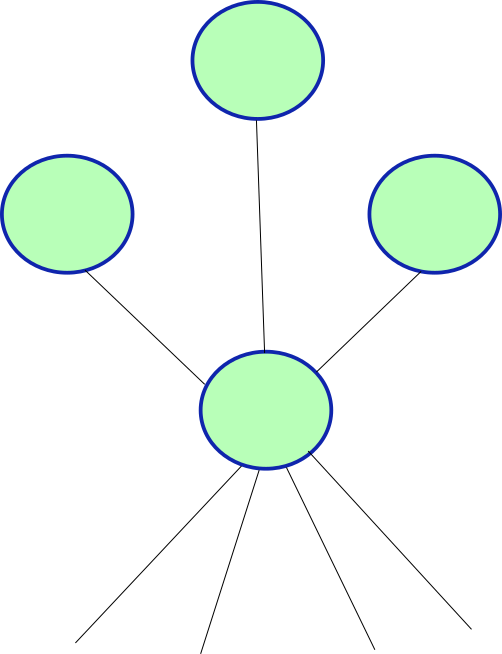
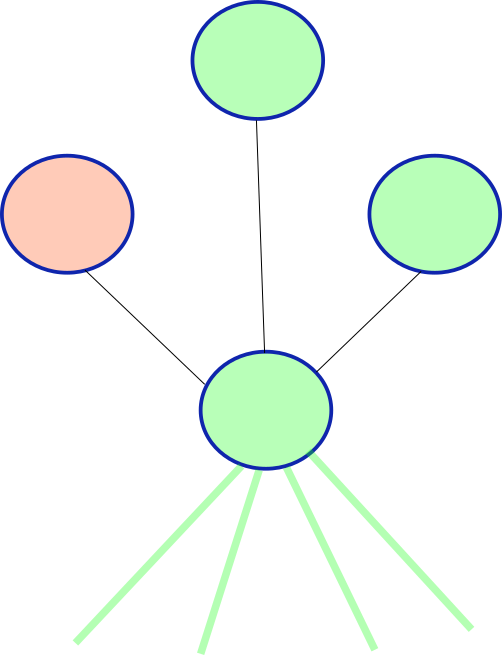
  • They are connected to other neurons

Connected Neurons

  • They are connected to other neurons
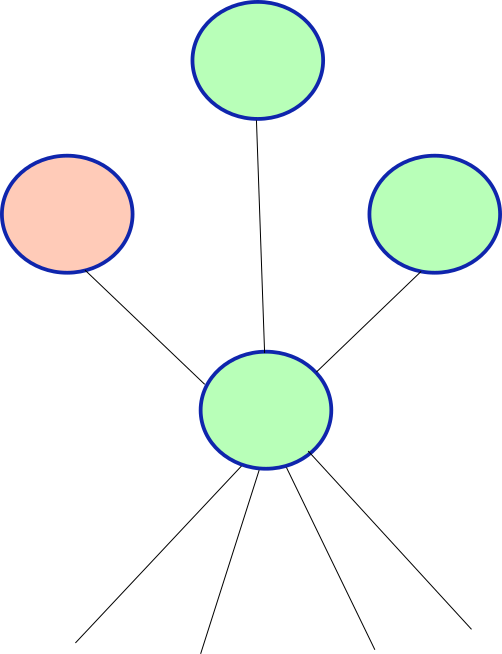
  • They respond to stimulus from senses and other neurons
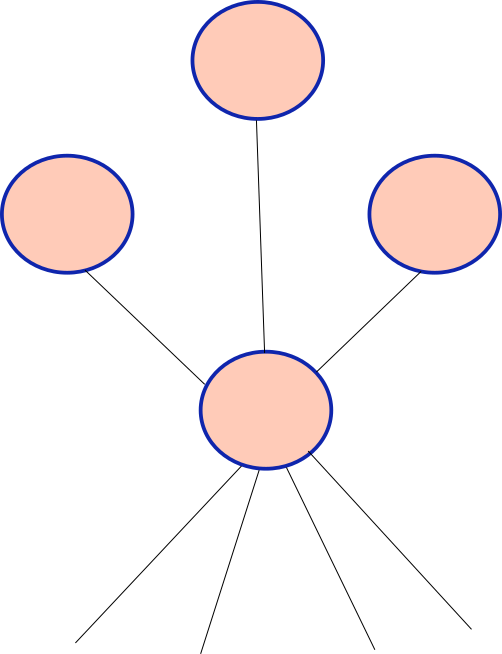
Connected Neurons

  • They are connected to other neurons
  • They respond to stimulus from senses and other neurons
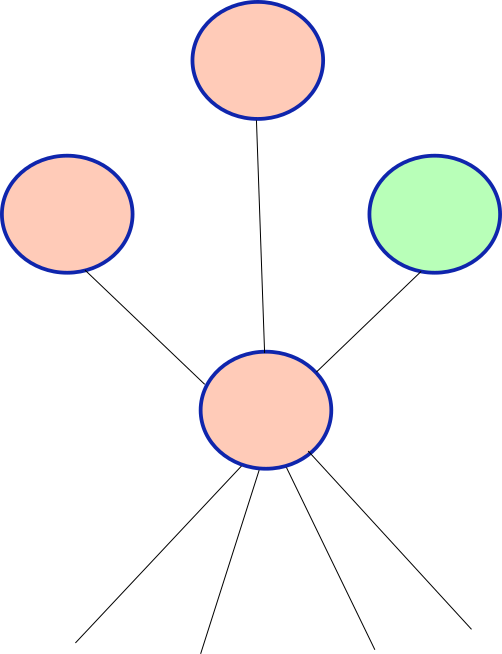
Connected Neurons

  • They are connected to other neurons
  • They respond to stimulus from senses and other neurons
  • Cross a threshold before firing

Connected Neurons

  • They are connected to other neurons
  • They respond to stimulus from senses and other neurons
  • Cross a threshold before firing

Connected Neurons

  • They are connected to other neurons
  • They respond to stimulus from senses and other neurons
  • Cross a threshold before firing
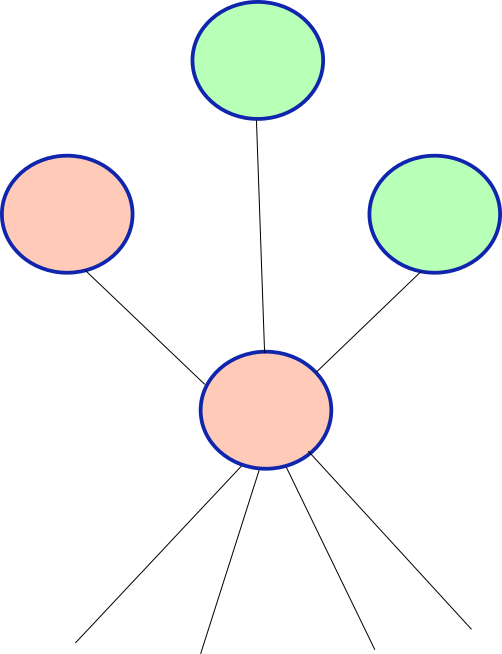
  • Neuronal Cascade is part of cognition

Single Neuron

  • Single Neuron converts several inputs into an output:
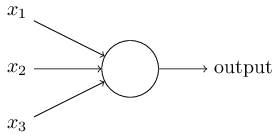
Nielson

Single Neuron

  • Integrates over the input signals using weights: \[ x_{\mathrm{out}} = \phi\left(\sum_{i=1}^n w_ix_i + c\right) \]

Single Neuron

  • Integrates over the input signals using weights: \[ x_{\mathrm{out}} = \phi\left(\sum_{i=1}^n w_ix_i + c\right) \]

  • \(\phi\) is called the activation function

  • \(w_i\) are the weights

  • \(c\) is the bias

Activation Functions

  • Biology intuition:
    • \(\phi=1\) when integrated inputs positive
    • \(\phi=0\) or \(\phi=-1\) (doesn’t matter) when integrated input negative
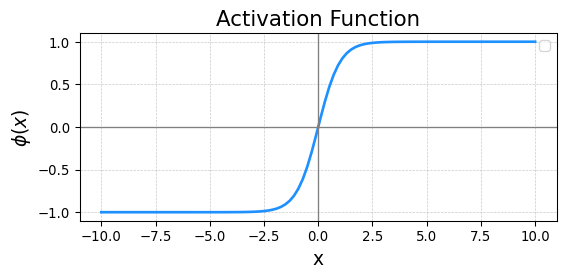
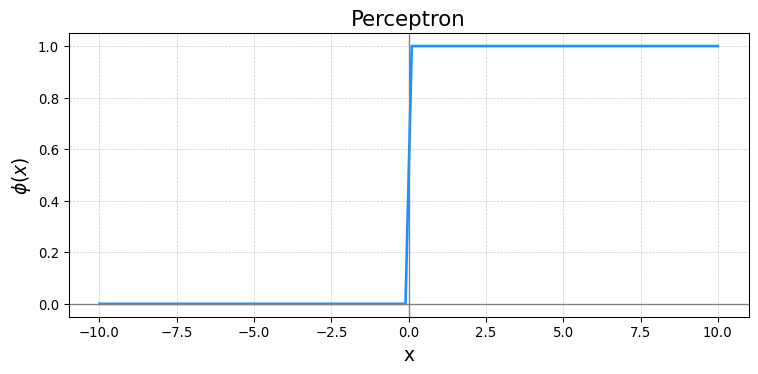
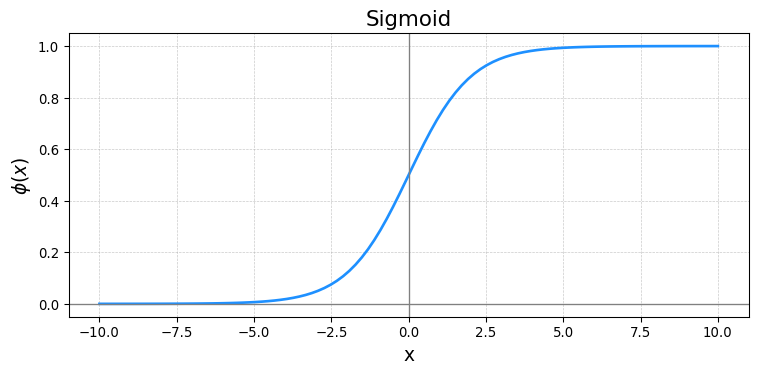
  • Leads to step/sigmoid functions:

Activation Functions to Know

  • Perceptron \[ \phi(x) = \cases{1& \text{if} \quad x\geq 0 \\ 0& \text{if} \quad x<0} \]
Activation Functions to Know

  • Sigmoid Function

\[ \phi(x) = \frac{1}{1+e^{-x}} \]
Activation Functions to Know

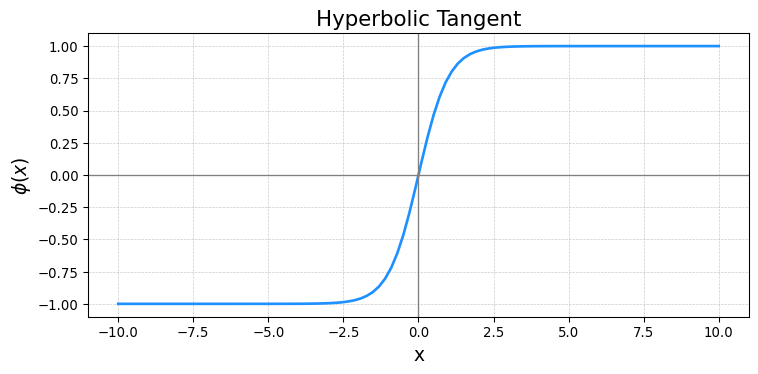
  • Hyperbolic Tangent

\[ \phi(x) = \frac{e^x - e^{-x}}{e^x +e^{-x}} \]
Activation Functions to Know

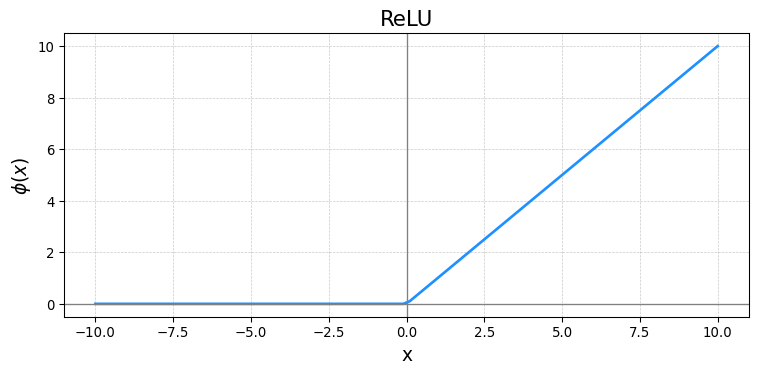
  • Rectified Linear Unit (ReLU)

\[ \phi(x) = \cases{0& \text{if} \quad x\geq 0 \\ x& \text{if} \quad x<0} \]
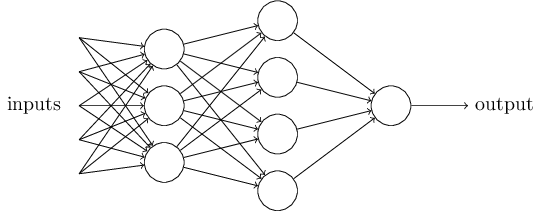
Feedforward Neural Networks

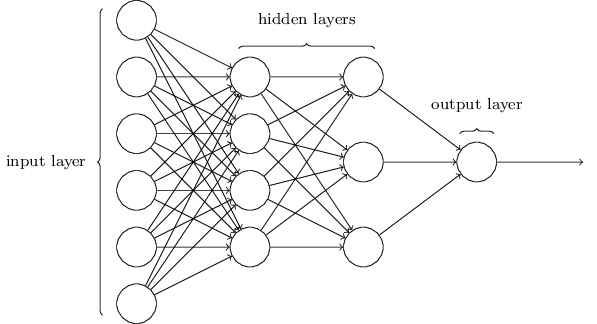
  • Input layer, one neuron per input variable
  • One neuron per target function
  • Neurons organized in layers

Feedforward Examples

  • Image Recognition
    • Input Neurons are pixels
    • Output neurons correspond to each category
    • Inner Layers Represent Features
    • Can use a softmax layer at the end to determine category

Neural Network Considerations

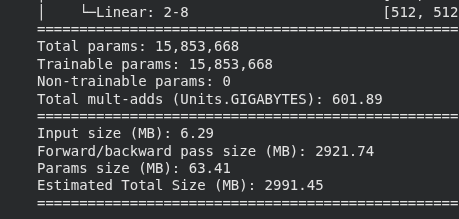
  • Even a small NN can be huge:
  • Need lots of data
  • Lots of different regularization

What are NNs used for?

  • Anything where the features are abstract
    • Images
    • Audio
    • Text
  • Large amounts of data
  • Tabular data problems decision trees often just as good but with less trouble

How would you train one?

  • Have set of training data \(\mathbf{x}_i\) and target \(y_i\)
  • Have settled on an architecture:
    • \(n_i\) neurons in layer \(i\)
    • \(m\) total layers
    • \(w_{jk,i}\) is weight of neuron \(j\) in layer \(i-1\) on neuron \(k\) in layer \(i\)
    • \(b_{ki}\) is bias of neuron \(k\) in layer \(i\)

How would you train one?

  • Overall neural network generates a function: \[ y_{\mathrm{pred}} = F(\mathbf{x}) \]
  • Evaluate function by stepping through the layers in order
  • Can define a loss minimization problem: \[ \min_{\mathbf{w},\mathbf{b}} \sum_{l=1}^N \Phi(y_l,F(\mathbf{x},\mathbf{w},\mathbf{b})) \]

Backpropagation

  • In order to optimize, compute the gradient
  • Repeated application of the chain rule
  • NN packages use the network structure to efficiently compute the gradients
  • Referred to as backpropagation
  • Related technique of automatic differentiation

pytorch

  • Open Source Machine Learning Library from Meta/FB
  • PyTorch optimizes usability while maintaining good performance
    • No small task when dealing with GPUs
  • PyTorch favors simple over easy
    • A little bit harder at first when working with GPUs
    • But easier to debug when you build complex models
  • Python First

tensors

  • Primary data object in pytorch is called a tensor
import torch
import numpy as np

data = [[1, 2],[3, 4]]
x_data = torch.tensor(data)
x_data
tensor([[1, 2],
        [3, 4]])

tensors

  • Tensors are like magic numpy arrays
    • They live on a particular device:
print(f"Device tensor is stored on: {x_data.device}")
Device tensor is stored on: cpu
  • When programming with GPUs, you must manually control the movement of tensor data across the cluster

What is a GPU

  • Normal computers have several (~20) very powerful cores
    • Each core can do complex operations sequentially
  • GPU has huge number (~10,000) of very basic cores
    • Cores can just multiply and add
    • Cores work in parallel
    • Perfect for Neural Networks

tensors

  • Tensors are like magic numpy arrays
    • They come with automatic gradient tracking
    • When you perform a computation with a tensor, pytorch stores the computational graph
    • *.backward() computes gradient
x = torch.ones(5)  # input tensor
y = torch.zeros(3)  # expected output
w = torch.randn(5, 3, requires_grad=True)
b = torch.randn(3, requires_grad=True)
z = torch.matmul(x, w)+b
loss = torch.nn.functional.binary_cross_entropy_with_logits(z, y)

loss.backward()

tensors

  • loss.backward() updated the tensors w and b to include the gradient with respect to loss \[ \frac{\partial \mathrm{loss}}{\partial \mathbf{w}},\quad \frac{\partial \mathrm{loss}}{\partial \mathbf{b}}, \]
print(w.grad)
print(b.grad)
tensor([[0.0065, 0.3193, 0.2655],
        [0.0065, 0.3193, 0.2655],
        [0.0065, 0.3193, 0.2655],
        [0.0065, 0.3193, 0.2655],
        [0.0065, 0.3193, 0.2655]])
tensor([0.0065, 0.3193, 0.2655])

Dataloaders

  • pytorch is written to separate model building/training and dataset management
  • torch.utils.data.Dataset enables built in datasets
  • torch.utils.data.DataLoader is for managing and iterating over datasets

DataLoaders

  • This code will download the fashion-mnist dataset and prep it for use:
import torch
from torch.utils.data import Dataset
from torchvision import datasets
from torchvision.transforms import ToTensor
import matplotlib.pyplot as plt


training_data = datasets.FashionMNIST(
    root="data",
    train=True,
    download=True,
    transform=ToTensor()
)

test_data = datasets.FashionMNIST(
    root="data",
    train=False,
    download=True,
    transform=ToTensor()
)

Constructing a Neural Network

  • Neural Network architectures are constructed using the nn.Module class
import torch.nn as nn
import torch.nn.functional as F
import torch.optim as optim


# The network class contains the intializer and some methods for our neural network
# You create a network by calling Network([Nodes_Input,Nodes_2,Nodes_3,...,Nodes_Output]) 

class Network(nn.Module):
    def __init__(self, sizes):
        super(Network, self).__init__()
        self.sizes = sizes
        self.num_layers = len(sizes)
        
        self.layers = nn.ModuleList()
        for i in range(self.num_layers - 1):
            layer = nn.Linear(sizes[i], sizes[i+1])
            nn.init.xavier_normal_(layer.weight)   # Good initialization for shallow/sigmoid nets
            #nn.init.kaiming_normal_(layer.weight, mode='fan_out', nonlinearity='relu') initialization for relus
            #nn.init.kaiming_uniform_(layer.weight, mode='fan_out', nonlinearity='relu') initialization for relus and deep nets

            nn.init.zeros_(layer.bias)               # initialize the bias to 0
            self.layers.append(layer)
    
    # Forward is the method that calculates the value of the neural network. Basically we recursively apply the activations in each
    # layer
    
    def forward(self, x):
        for layer in self.layers[:-1]:
            x = nn.sigmoid(layer(x))   # sigmoid layers
            #x = F.relu(layer(x)) # You will try the relu layer in the last problem
        x = self.layers[-1](x) 
        return x

Initializing a Network

  • Can call the constructor to make your network:
Network([784,100,10])
Network(
  (layers): ModuleList(
    (0): Linear(in_features=784, out_features=100, bias=True)
    (1): Linear(in_features=100, out_features=10, bias=True)
  )
)

Training a network

  • Define Training Function
def train(network, train_data, epochs, eta, test_data=None):
 
    optimizer = optim.SGD(network.parameters(),momentum=0.8,nesterov=True, lr=eta,weight_decay=1e-5)
    loss_fn = nn.CrossEntropyLoss()
    
    loss_history = []      
    accuracy_history = []  
    train_accuracy_history = []

    # We are going to loop over the epochs
    for epoch in range(epochs):
        # This puts the network into training mode
        network.train()
        running_loss = 0.0
        batch_count = 0

Training a Network

  • Loop over batches of training examples
        # Now we loop through the batches to train
        for data, target in train_data:
            optimizer.zero_grad() # This clears the internally stored gradients
            output = network(data) # evaluate the neural network on the minibatch, we will compare this to the target
            # Here we calculate the loss function and then use backpropagation
            # to calculate the gradient
            loss = loss_fn(output, target) 
            loss.backward()
        
            # Update the weights
            optimizer.step()
            
            running_loss += loss.item()
            batch_count += 1

Loading Data

from torchvision import datasets, transforms
from torch.utils.data import DataLoader

transform = transforms.Compose([transforms.ToTensor(), transforms.Lambda(lambda x: x.view(-1))])


train_dataset = datasets.FashionMNIST('data/', train=True, download=True, transform=transform)
test_dataset = datasets.FashionMNIST('data/', train=False, transform=transform)

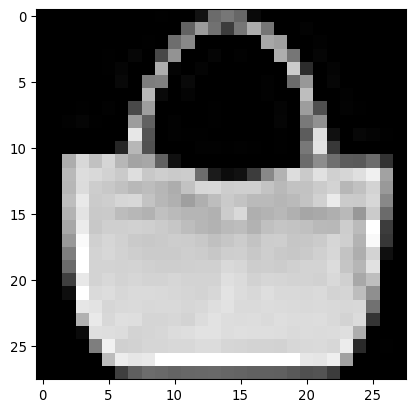
img, label = training_data[100]

plt.imshow(img.squeeze(),cmap="gray")
Train

train_loader = DataLoader(train_dataset, batch_size=10, shuffle=True)
test_loader = DataLoader(test_dataset, batch_size=10, shuffle=False)

# Initialize network
net = Network([784, 30, 10])

# Train
train(net, train_loader, epochs=1, eta=0.01, test_data=test_loader)

Optimization Basics

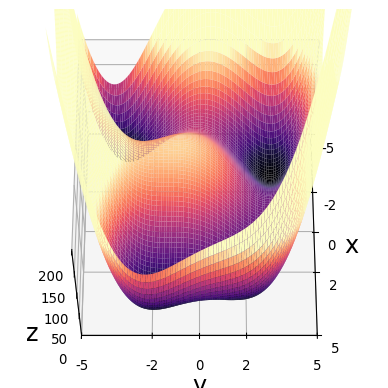
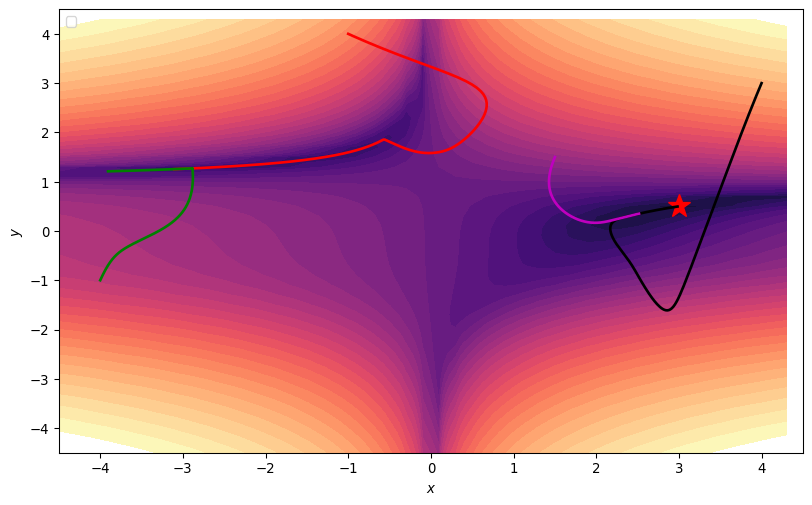
  • Simplified loss landscape:
  • Imagine more dimensions

Gradient Descent
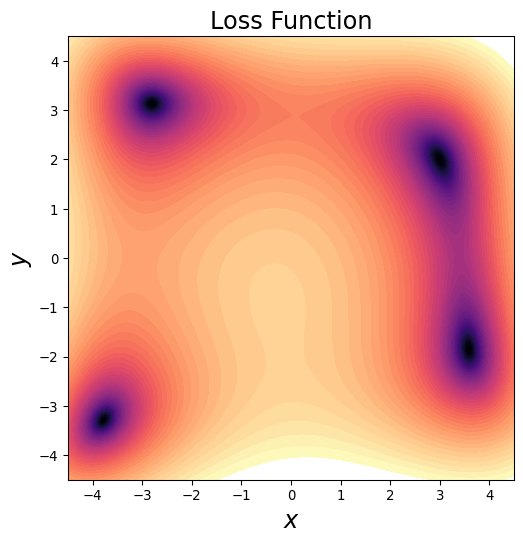
  • Start at \(\mathbf{x}_0\)
  • Find gradient \(\nabla \mathrm{loss}(\mathbf{x})\)
  • \(\mathbf{x}_n = \mathbf{x}_{n-1} - \kappa \nabla\mathrm{loss}(\mathbf{x}_{n-1})\)
  • \(\kappa\) is learning rate

What Learning Rate to Pick?
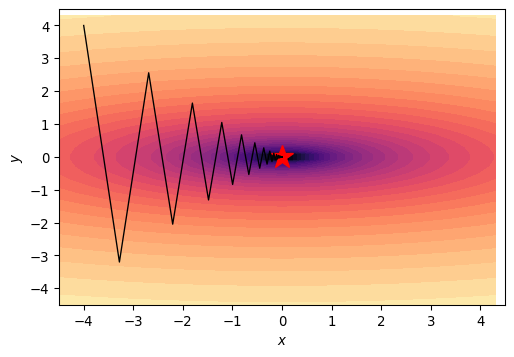
  • High learning rate trains faster
  • Too high and don’t converge at all
  • Limit is set by algorithm and ellipticity of well

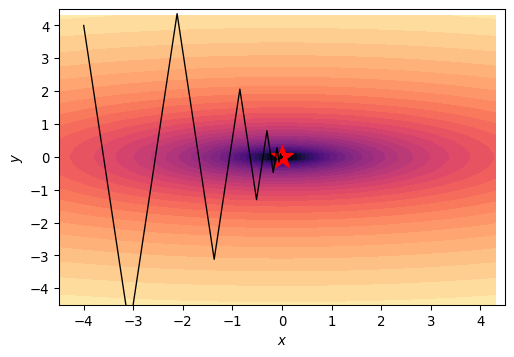
What Learning Rate to Pick?

  • Steepness discrepancy limits learning rate
  • Most of the step is in wrong direction

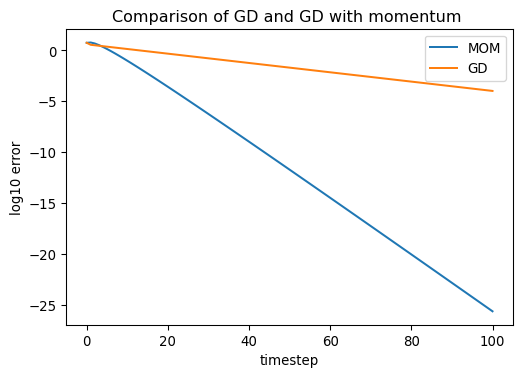
Momentum

  • Advanced algos use momentum, gives “memory” of past gradient
  • Reduces effect of valley oscillation

Hyperparameter Problems

  • We don’t know the shape of the loss landscape to pick \(\kappa\)
  • We handle this several ways:
    • Experimentation
    • Heuristics
    • Adaptive Methods

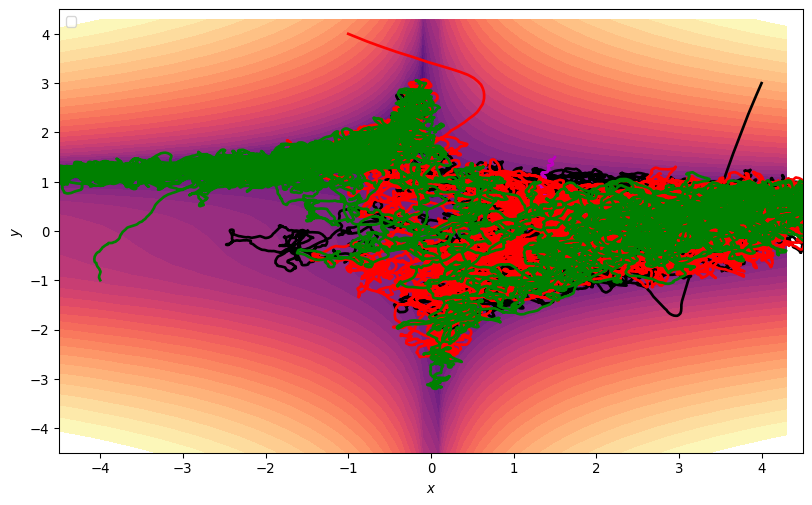
Stochastic Gradient Descent

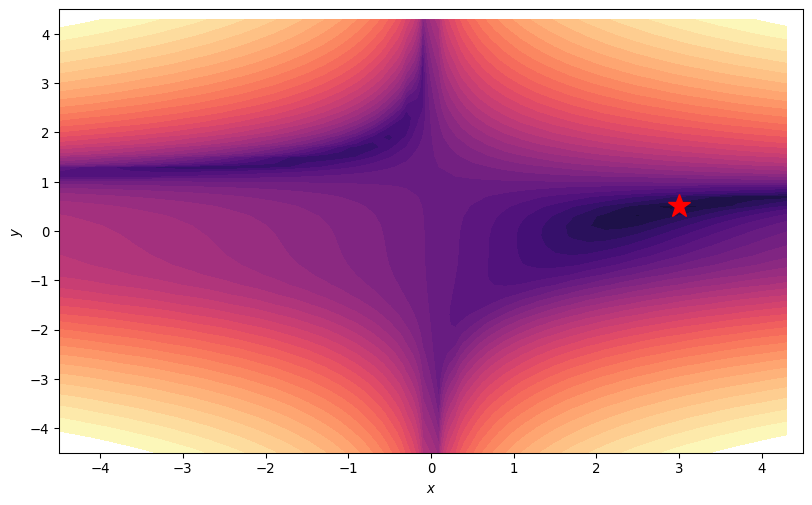
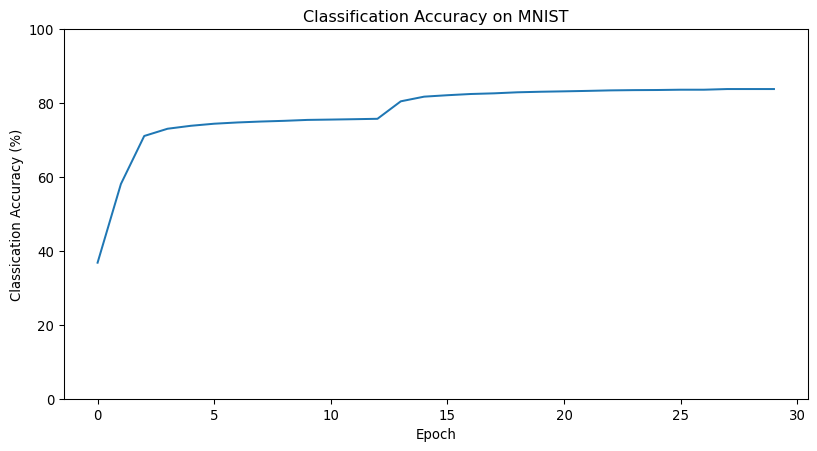
  • Common for optimization algorithms to “get stuck”
Stochastic Gradient Descent

  • In low-D local minima are problematic

Stochastic Gradient Descent

  • Trajectories get Stuck

Stochastic Gradient Descent
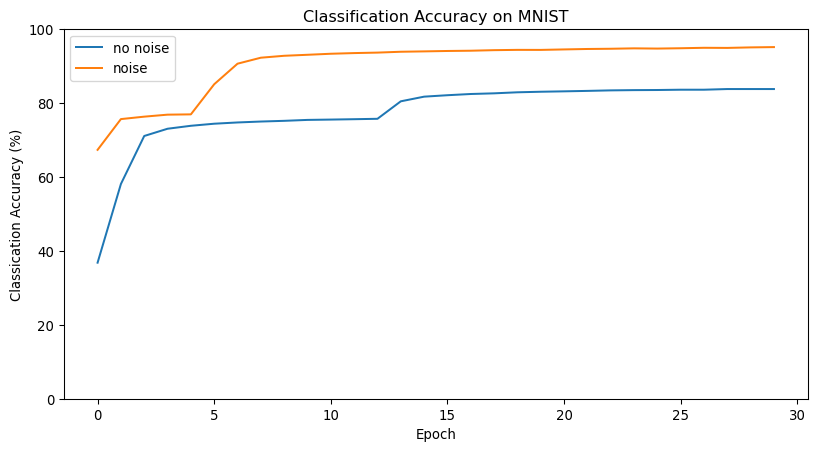
  • The barriers in high dimensions likely more complex
  • Stochastic Gradient Descent modifies gradient descent style methods
    • Compute the gradient of loss using only part of the data
    • Called a “mini-batch”
    • Smaller the mini-batch, the more the noise

Stochastic Gradient Descent

Stochastic Gradient Descent

  • In 2D, can just add noise

Annealing

  • Noise can deflect you from the minimum when you are close
  • Common practice is to start with noise high, reduce it later
    • Simulated annealing (from metallurgy)
  • Even more common to start with high learning rate and gradually decrease it
    • Whereas in some ML applications increasing batch-size could cause overfitting

Adaptive Methods

  • We saw that hyper-parameters are hard to pick at outset
  • Ideal learning rate depends on condition number and also magnitude of gradients
  • Concept: Change Learning Rate as we go
    • Keep memory of gradient in each variable
    • Step in the direction of the average gradient
    • Decrease learning rate if variance is high
    • Increase learning rate if variance is low

ADAM

  • Adaptive Moment Estimation
  • Have a local estimate of average gradient \(\hat{\mathbf{v}}_i\)
  • Have a local estimate of squared gradient \(\hat{G}_{s,i}\)
  • Adjusted learning rate based on both: \[ \mathbf{x}_{i+1} = \mathbf{x}_i -\kappa \frac{\hat{\mathbf{v}}_i}{\sqrt{\hat{G}_{s,i}+\epsilon}} \]

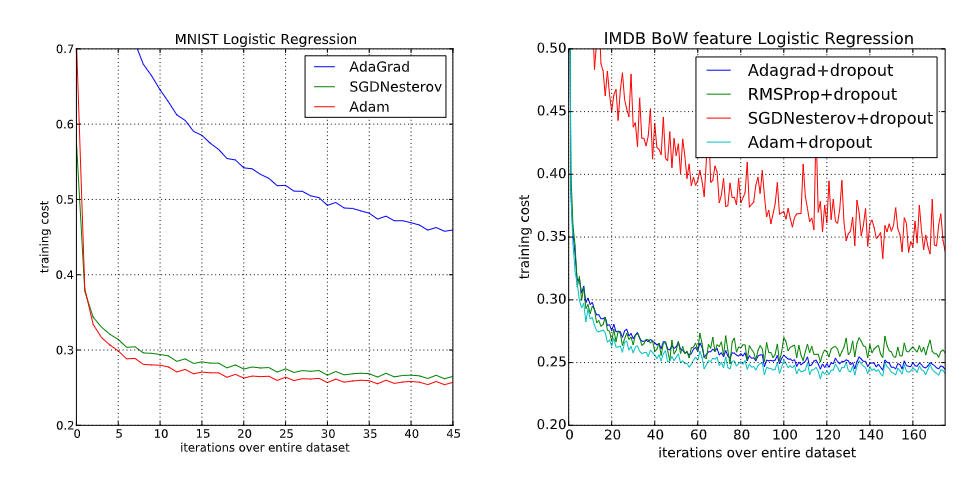
When and Why is ADAM good?

  • ADAM is much more robust to learning rate choices

  • ADAM is excellent when the gradient is sparse

  • ADAM is often the best in initial training stages

When is ADAM bad?

  • ADAM is perhaps the most widely used optimizer, the default for deep learning
  • However, it is not even guaranteed to converge on easy problems
  • Can generalize worse (need more regularization)
  • Less memory efficient
  • It is very heuristic in nature, can be improved

Thanks