DATA 622 Meetup 14: RNNs and Text

George I. Hagstrom

2026-05-04

Week Summary

  • CIFAR100 problem: Lab 7 Due 5/10
    • Lab 8 shortened, available soon
  • Schedule Final Presentations Next Week
  • RNNs and Text this week
  • Pretrained Models next week

nyhackr Thursday May 14th!

nyhackr Thursday May 14th!

  • Christian Martinez
  • R package for interacting with NYCOpenData

End of Semester Gathering?

  • Post in the Slack if you are interested!

Sequential Data

  • Data has a one-dimensional order:

ISLP

Sequential Data

  • Data has a one-dimensional order:
    • Sound/Music
    • Text
    • DNA/Proteins/RNA
    • Position of a moving object
    • User Behavior

Recurrent Neural Networks

  • Take advantage of the inductive bias:
    • What comes next depends on what came before

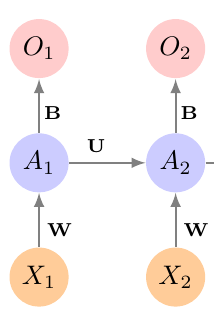
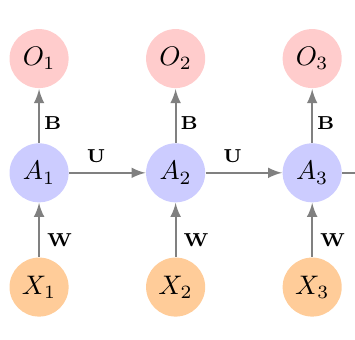
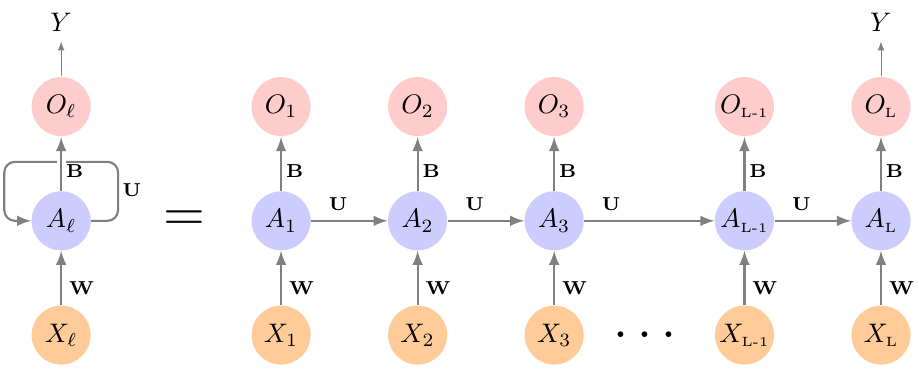
Apply the network to the data sequentially

Apply it to the old activations and next state

Repeat

Use the final output for your prediction
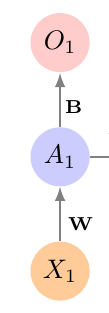
RNN Architecture

  • Network has \(K\) internal layers
  • Activations \(A_{lk}\) at sequence point \(l\)
  • Need weights for the inputs \(X_{il}\):

\[ A_{lk} = g\left(\sum_{j=1}^p w_{jk} X_{lj} + \cdots \right) \]

RNN Architecture

  • Network has \(K\) internal layers
  • Activations \(A_{lk}\) at sequence point \(l\)
  • Need weights for the old activations \(A_{(l-1),s}\):

\[ A_{lk} = g\left(\sum_{j=1}^p w_{jk} X_{lj} + \sum_{s=1}^K u_{sk} A_{(l-1),s} + \cdots \right) \]

RNN Architecture

  • Network has \(K\) internal layers
  • Activations \(A_{lk}\) at sequence point \(l\)
  • Need a bias:

\[ A_{lk} = g\left(w_{0k} +\sum_{j=1}^p w_{jk} X_{lj} + \sum_{s=1}^K u_{sk} A_{(l-1),s} \right) \]

RNN Architecture

  • Need to Calculate Output \(O_l\):
  • Regression:

\[ O_l = \beta_0 + \sum_k=1^K \beta_k A_{lk} \]

RNN Architecture

  • Need to Calculate Output \(O_l\):
  • Classification:

\[ O_l = g(\beta_0 + \sum_k=1^K \beta_k A_{lk}) \]

RNN Architecture

  • Need to Calculate Output \(O_l\):
  • Can also calculate \(O_l\) using some additional layers

RNN Use Cases

  • Time Series (624…..)
    • But check out Reservoir Computing
  • All sorts of device use cases
  • Audio processing
  • NLP (But have been superseeded recently)

RNN Example: IMDB Sentiment

imdb.com

  • IMDB contains millions of movie reviews
  • Can we predict sentiment from text?

How Can a Neural Network Read?

  • NLP always involves feature engineering:
    • Tokenize into words or n-grams
    • Use Sentiment Lexicon
    • One-Hot Encode and use ML?

One-Hot and Meaning?

  • Consider words “angry” and “mad”
    • Almost the same word
    • Training treats them as independent
  • Word meaning is a type of “inductive bias” that we want

Solution: Low Dimensional Embedding

  • Goal: Find mapping from 10,000 dimensional word space to lower dimensional “meaning” space
  • Consider Word “King” in One-Hot \[ \mathrm{King}_{OH} = (0\, 0\, \cdots\, 0\, 1\, 0\, \cdots\, 0) \]
  • In Embedded Representation: \[ \mathrm{King}_{e} = (-1.1\, 0.3\, \cdots\, 2.2) \]

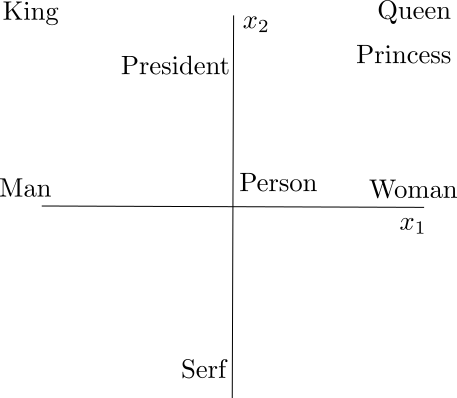
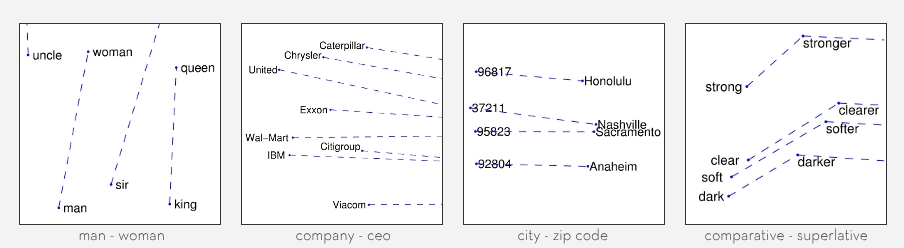
Similar Words Cluster Together

  • Queen and Princess are near

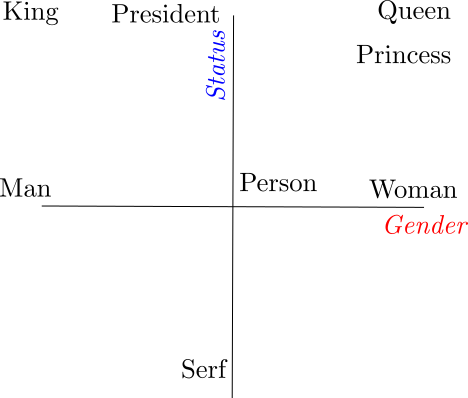
Features May Be Interpretable

  • One axis is Gender, other is Status

Dimension Reduction

  • Each word is now a vector in \(m\)-dimensional space
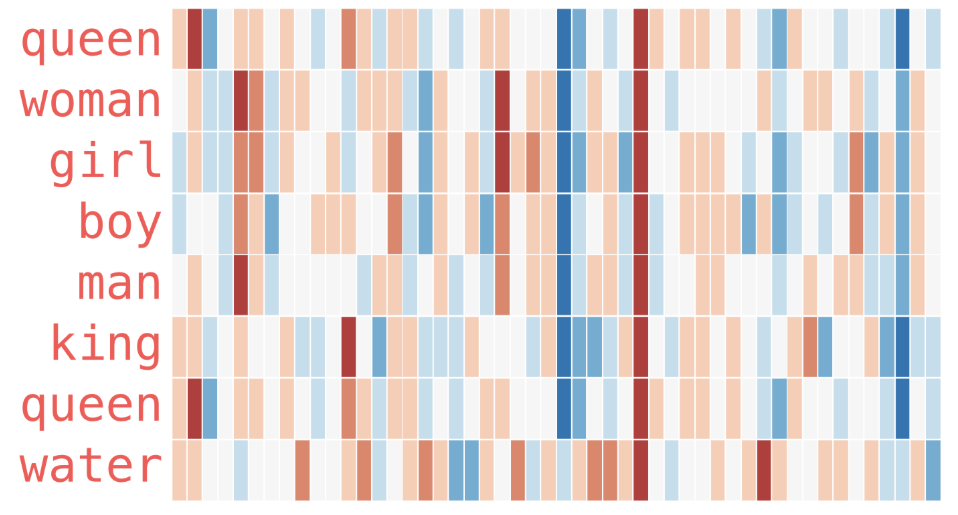
Jay Alammar

How to Embed?

  • DIY Option:
    • Pick a dimension \(m\)
    • Learn \(10000 \times m\) weights
class LSTMModel(nn.Module):
    def __init__(self, input_size):
        super(LSTMModel, self).__init__()
        self.embedding = nn.Embedding(input_size, 64)

How to Embed?

  • DIY Option:
    • Pick a dimension \(m\)
    • Learn \(10000 \times m\) weights
    • Weights are trained from scratch each time
    • Embedding is unsophisticated, but optimized to your problem

How to Embed?

  • Pretrained Options
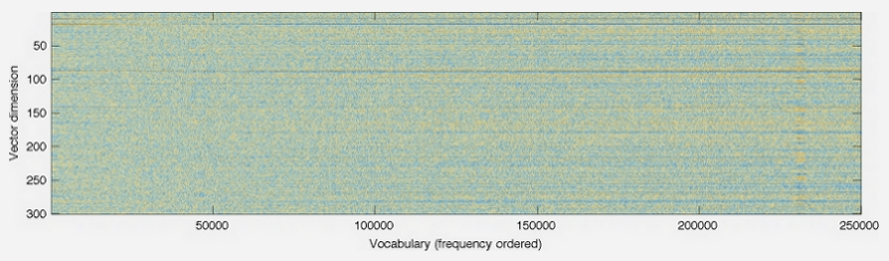
    • Global Vectors for word representation (GloVe)
    • Trained on wikipedia text, up to 300 dimensions:
How to Embed?

  • Pretrained Options
    • Global Vectors for word representation (GloVe)
    • Trained on wikipedia text, up to 300 dimensions:
How to Embed?

  • Pretrained Options
    • GloVe
    • Word2Vec
    • BERT (though it is more complicated)
class LSTMModel(nn.Module):
    def __init__(self, input_size):
        super(LSTMModel, self).__init__()
        self.embedding = nn.Embedding.from_pretrained(
            glove_embeddings,
            freeze=True
            )

Fine Tuning

  • Pre-trained embeddings have been trained on huge corpuses of data
  • Similar networks exist in other domains, ResNet for images
  • freeze=False fine-tunes those weights
  • Fine-tuning allows you to adapt part or the whole of a sophisticated model to your particular task

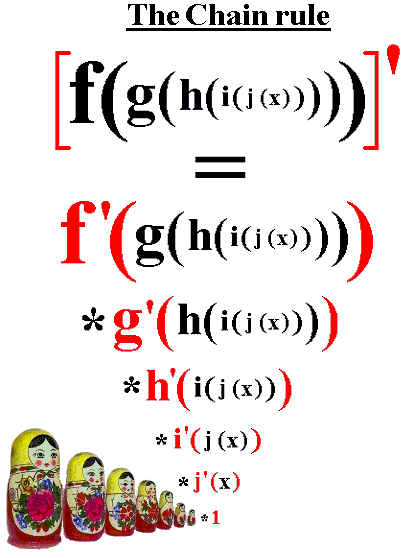
Vanishing Gradients in RNNs

  • RNNs cause vanishing gradients
  • ReLU can’t be used!
  • Sequence length compounds it
  • RNNs lose key information

wikipedia

Long Short Term Memory

  • LSTM was invented to handle this
  • RNN just has activations \(A\)
    • Renamed \(h\) for LSTM
  • LSTM has a “memory” called \(C\) (Cell State)

Cell State Updates

  • Each new token, update \(C_l\)
  • Forget part of \(C_{l-1}\)
  • Add new info from \(X_{l}\) and \(h_{l-1}\)

\[ C_l = f_l C_{l-1} + i_l \tilde{C}_l \]

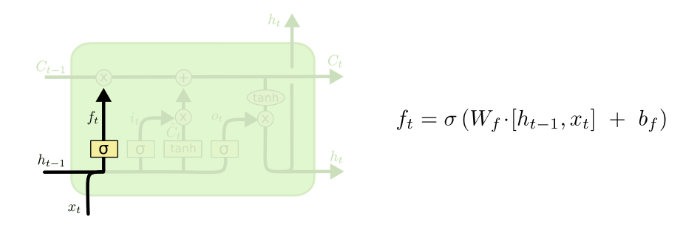
Forgetting

  • Forgetting is number between 0 and 1
  • Depends on \(h_{l-1}\) and \(X_l\)

Christopher Olah

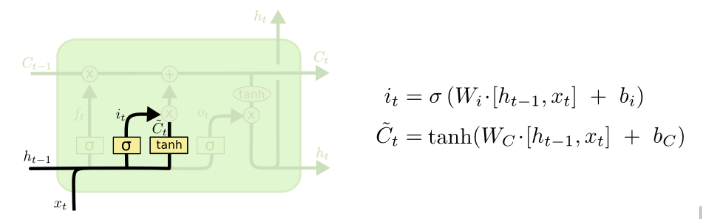
Input

  • Input is number between 0 and 1
  • Candidate state is new info to add

Christopher Olah

Cell State Update Diagram

  • Ready for the update

Christopher Olah

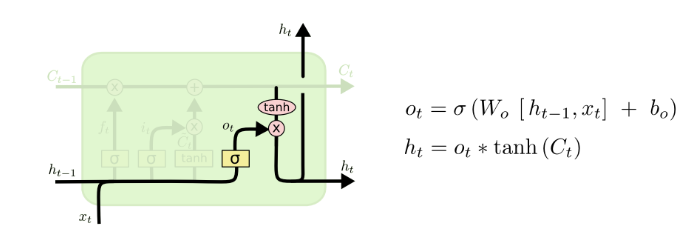
Update Hidden State

  • The hidden state is calculated from the cell state

Christopher Olah

PyTorch Implementation

class LSTMModel(nn.Module):
    def __init__(self, input_size):
        super(LSTMModel, self).__init__()
        self.embedding = nn.Embedding(input_size, 64)
        self.lstm = nn.LSTM(input_size=64,
                            hidden_size=64,
                            batch_first=True)
        self.dense = nn.Linear(64, 1)
    def forward(self, x):
        val, (h_n, c_n) = self.lstm(self.embedding(x))
        return torch.flatten(self.dense(val[:,-1]))

LSTM Architecture Tips

  • Hidden Layers Become Harmful Fast
    • LSTM doesn’t totally eliminate vanishing gradients
  • Width depends on your training data
  • Dropout, weight decay, layer norm, early stopping, data augmentation
    • Weight Freezing for Embedding

Optuna

  • How do we systematically search to find the best hyperparameters when there are many?
  • Grid Search is ineffcient when there are many parameters
  • Better: Sample parameters randomly, bias to where you have been getting better results

Optuna Code

  • Choose your hyperparameters and their ranges:
def lstm_objective(trial):
    # Hyperparameters to optimize over
    embedding_dim = trial.suggest_categorical("embedding_dim", [16, 32, 64, 128])
    hidden_size = trial.suggest_categorical("hidden_size", [32, 64, 128])
    num_layers = trial.suggest_int("num_layers", 1, 3)
    dropout = trial.suggest_float("dropout", 0.0, 0.5)
    learning_rate = trial.suggest_float("learning_rate", 1e-4, 1e-2, log=True)
    weight_decay = trial.suggest_float("weight_decay", 1e-6, 1e-2, log=True)
    batch_size = trial.suggest_categorical("batch_size", [128, 256, 512])

Optuna Code

  • Make you NN class depend on the values
class TrialLSTMModel(nn.Module):
        def __init__(self, input_size):
            super(TrialLSTMModel, self).__init__()
            self.embedding = nn.Embedding(input_size, embedding_dim)
            self.drop1 = nn.Dropout(dropout)
            self.lstm = nn.LSTM(input_size=embedding_dim,
                                hidden_size=hidden_size,
                                num_layers=num_layers,
                                dropout=dropout if num_layers > 1 else 0,
                                batch_first=True)
            self.drop2 = nn.Dropout(dropout)
            self.dense = nn.Linear(hidden_size, 1)

Optuna Code

  • Run the trial!
study = optuna.create_study(direction="maximize")
study.optimize(lstm_objective, n_trials=20)
  • You will need a bit more boilerplate but its not bad
  • There are a lot of sophisticated features

Get a small boost

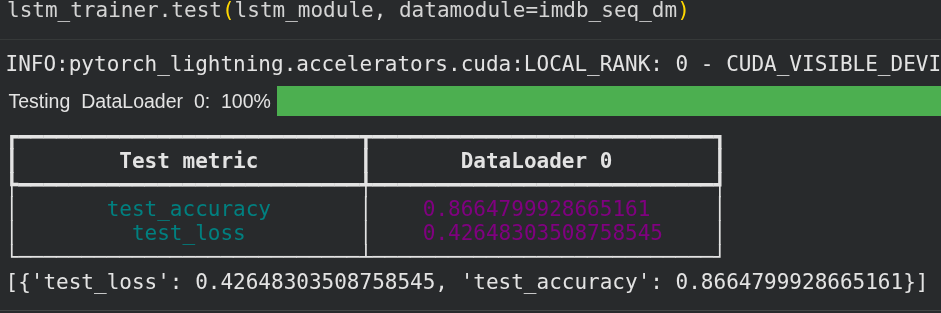
  • Before tuning 86%

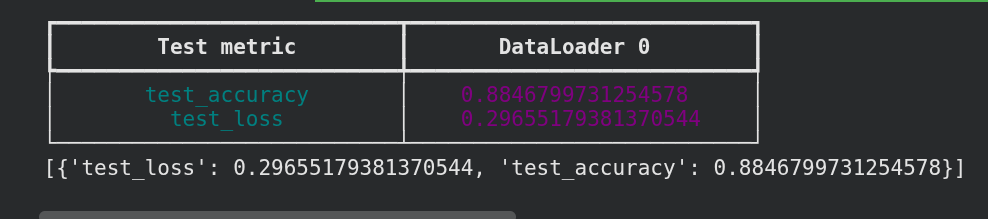
  • After tuning 88%

Thanks