DATA 622 Meetup 15: Pretrained Models

George I. Hagstrom

2026-05-11

Week Summary

  • Optional Lab 8
  • Presentations!
  • Pretrained Models: Different Reading
  • Coding Vignette Posted (without video)

nyhackr Thursday May 14th!

Lab Comments

  1. No ridge regression without using the standard scaler!!!
  2. Pick CausalML Hyperparameters to Make things Smooth
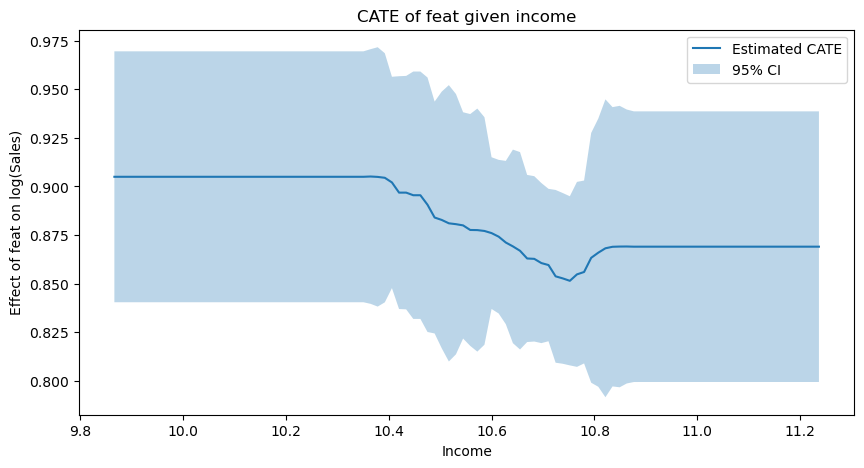
est = CausalForestDML(
    model_y=LassoCV(cv=3),
    model_t=LogisticRegressionCV(cv=3),
    n_estimators=8000,
    min_samples_leaf=50,
    #max_depth=5,
    max_samples=0.02,
    discrete_treatment=True,
    random_state=123
)

Lab Comments

  1. No ridge regression without using the standard scaler!!!
  2. Pick CausalML Hyperparameters to Make things Smooth

Lab Comments

  1. No ridge regression without using the standard scaler!!!
  2. Aggressive Choices Lead to Aggressive Fits
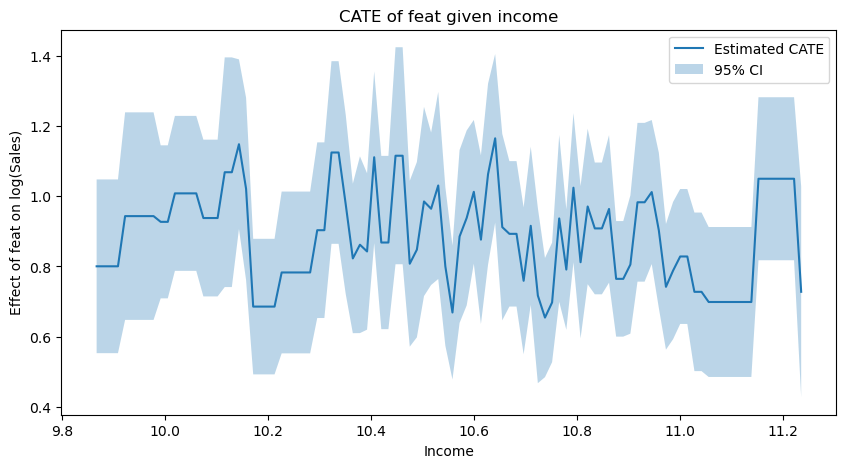
est = CausalForestDML(
    model_y=LassoCV(cv=3),
    model_t=LogisticRegressionCV(cv=3),
    n_estimators=8000,
    min_samples_leaf=10,
    max_depth=40,
    max_samples=0.45,
    discrete_treatment=True,
    random_state=123
)

Lab Comments

  1. No ridge regression without using the standard scaler!!!
  2. Aggressive Choices Lead to Aggressive Fits

Contextual Meaning

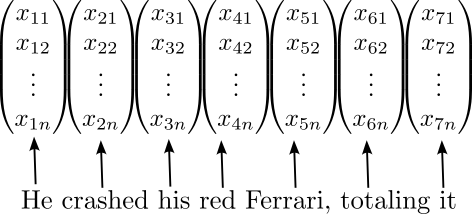
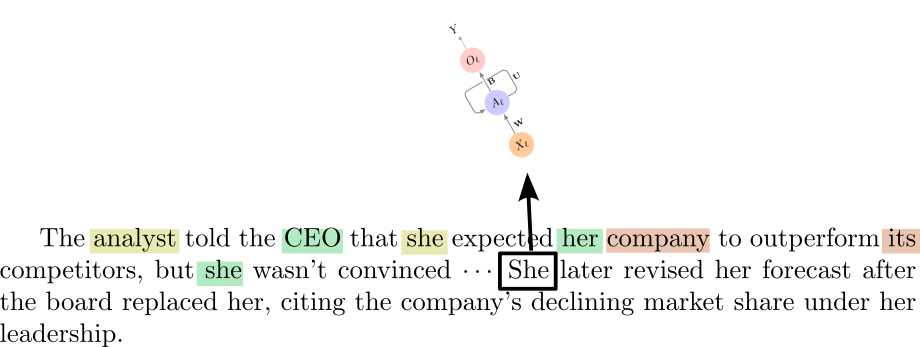
  • Consider an LSTM Processing this Text

Contextual Meaning

  • Pronouns embedded as vectors, but mean specific things

Contextual Meaning

  • LSTM incorporates their meaning via long-range states

Contextual Meaning

  • Later, same pronouns may occur

Contextual Meaning

  • LSTM’s understanding too compressed to remember previous context
Context

  • Distant words hold key context

Attention

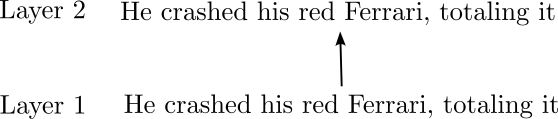
  • Attention is a mechanism to “update” the meaning of a word based on the surrounding context

Attention

  • Consider simple sentence

Attention

  • Each token has an embedding

Attention

  • Nearby tokens give context, change embedding in next layer
Attention

  • Accumulate changes to embedding in next layer
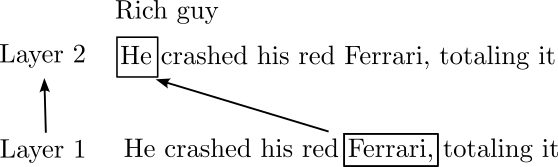
Attention

  • Accumulate changes to embedding in next layer
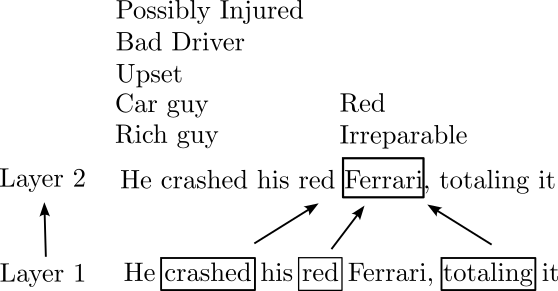
Attention

  • Accumulate changes to embedding in next layer
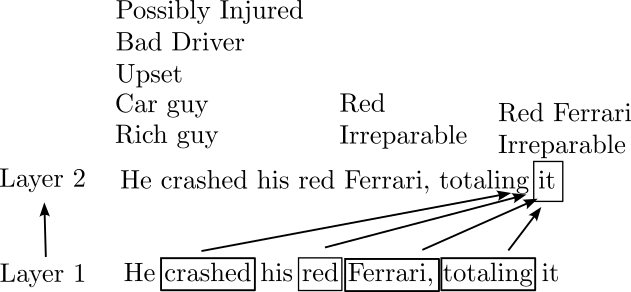
Transformer Achitecture

  • A transformer is an architecture containing layers of transformer blocks.
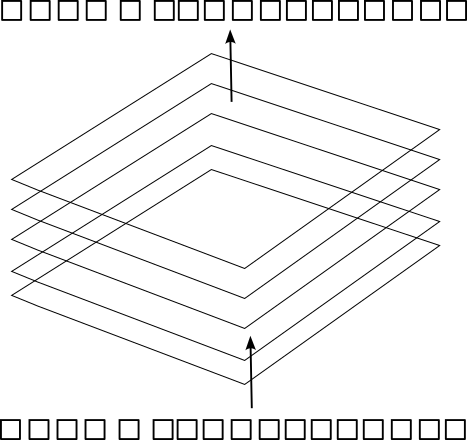
Transformer Layer

  • Transformer Layer has two parts:
    • Attention Mechanism
    • MLP layer betweem

Allocating Attention

  • Each attention head within a layer has several projections:
    • ‘q_proj’ and ‘k_proj’ determine which other tokens are relevant
    • ‘v_proj’ determines what information gets added if relevant
    • ‘o_proj’ combines the added info for each token

Encoder Models: BERT

  • 22 Transformer Layers
  • 150M paramters
  • Head is trained to predict masked words

Encoder Models: BERT

  • 22 Transformer Layers
  • 150M paramters
  • Head is trained to predict masked words

Encoder Models

  • Excel at all non-generative tasks
    • Classification
    • Named Entity Recognition
    • Similarity
  • Fast
  • Cannot Generate Text
  • Less Efficient Training

Decoder Models

  • ChatGPT, Claude, Gemini, Qwen, etc
  • Head is configured to predict next token probability

Decoder Models

  • Can sort of do anything
  • Easier to train
    • Can get bigger
    • People think they show more ‘emergence’

Fine Tuning Large Models

  • LLMs start life as “Base Models”
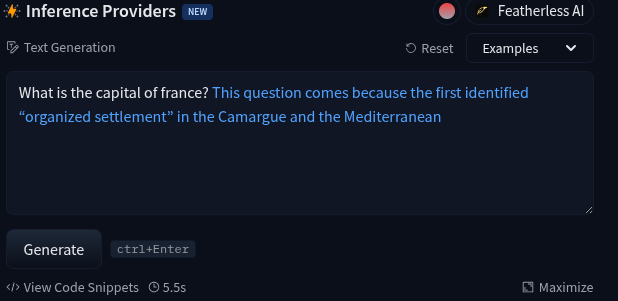
  • They just produce text:

Fine Tuning Large Models

  • To make LLMs useful, they must be specified to a task
  • Train them on examples of what you are looking for!
{"messages": [
  {"role": "user", "content": "What are the main risks of investing in bonds?"},
  {"role": "assistant", "content": "The main risks include interest rate risk, credit risk, and inflation risk..."},
  {"role": "user", "content": "Can you explain interest rate risk more?"},
  {"role": "assistant", "content": "When interest rates rise, existing bond prices fall because..."},
  {"role": "user", "content": "So should I avoid bonds when rates are rising?"},
  {"role": "assistant", "content": "Not necessarily. Short-duration bonds are less affected..."}
]}

Fine Tuning

  • Fine tuning works like regular training but:
    • Smaller Dataset
    • Fewer epochs
    • Sometimes only modify part of the network

Fine Tuning BERT

  • The entire thing:
# Extarct the BERT model
bert_model = AutoModelForSequenceClassification.from_pretrained(
    "answerdotai/ModernBERT-base", num_labels=3)

# Setup the training, this is the analog of the pytorch lightning trainer

bert_trainer = HFTrainer(
    model=bert_model,
    args=bert_training_args,
    train_dataset=hf_train_tok,
    eval_dataset=hf_val_tok,
    data_collator=DataCollatorWithPadding(bert_tokenizer), # Trick to save computation time
    compute_metrics=compute_metrics,
)

# Perform training
bert_trainer.train()

Fine Tuning BERT

  • Loop through and freeze/unfreeze!
    # Freeze lhe first N transformer layers via a loop
    
    for layer in bert_model.model.layers[:-N]:
        for param in layer.parameters():
            param.requires_grad = False

Fine Tuning BERT

  • Loop through and freeze/unfreeze!
  • Typical to fine-tune layers near the top

Fine Tune Big Models?

  • BERT has 150M parameters
  • Qwen 0.5B
  • Others have much more, some approach 1T parameters
  • Will NOT fit in your GPU RAM

LoRA

  • LoRA stands for Low Rank Adaptation
  • For the Linear Algebra Knowers:

\[ L = M_1 \times M_2^t \]

  • \(M_1\) and \(M_2\) are \(N\times r\) matrices
  • Way of generating full size matrix with small number of parameters to learn

LoRA

  • LoRA stands for Low Rank Adaptation
  • For the Linear Algebra Knowers:

\[ Q_{FT} = Q + \alpha L \]

LoRA

  • LoRA is standard technique to fine-tune large transformers
  • Key hyperparameters:
    • Rank \(r\): Higher \(r\) is more complex and costlier
    • Higher \(\alpha\): \(\alpha\) is “size” of perturbation
    • Components: ‘q_proj’ and ‘v_proj’, ‘MLP’ layer
  • Apply LoRA to every layer

LoRA Implementation

  • Hugging Faces has great tools for this
#Get model
qwen_model = AutoModelForCausalLM.from_pretrained(
    qwen_model_id,
    quantization_config=bnb_config,
    torch_dtype=torch.float16,  # force all non-quantized weights to float16
    device_map="auto"
)

# Setup LoRA
lora_config = LoraConfig(
    r=16, lora_alpha=32, lora_dropout=0.05,
    target_modules=["q_proj", "v_proj"],
    task_type="CAUSAL_LM", # Let it know that this model produces text recursively
)

LoRA Implementation

  • Hugging Faces has great tools for this
# Train/Fine Tune!!!
qwen_trainer = SFTTrainer(
    model=qwen_model,
    args=qwen_training_args,
    train_dataset=hf_train_fmt,
    eval_dataset=hf_val_fmt,
    peft_config=lora_config,
)

qwen_trainer.train()

LoRA Impact

  • Fine-Tuning leads to stunning performance improvements with relatively little effort

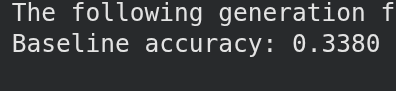
  • Original Model:

  • Fine Tuned Model:

Thanks!