DATA 622 Meetup 6: Resampling
2026-03-03
Week Summary
- Groups: Email me your members asap, also set up time to meet
- If not in a group, email me immediately if you want to get a grade for the proposal
- HW 4 available- it involves lots of reading but not as much work as it looks
- Chapter 5 of ISLP
Events
![]()
nyhackr.org
Events
- Data Science Seminar with Jiahao Chen
- Director of AI/ML at NYC Office of Technology
- Wednesday, March 25th at 6:30PM
Train-Test Redux
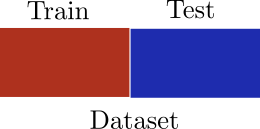
- Goal of Predictive Model Selection:
Best out of sample performance
- Hold out data for testing
![]()
Train-Test Redux
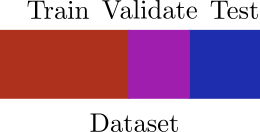
- If you are comparing many different models and features, sometimes need three datasets
![]()
Train-Test Split Problems
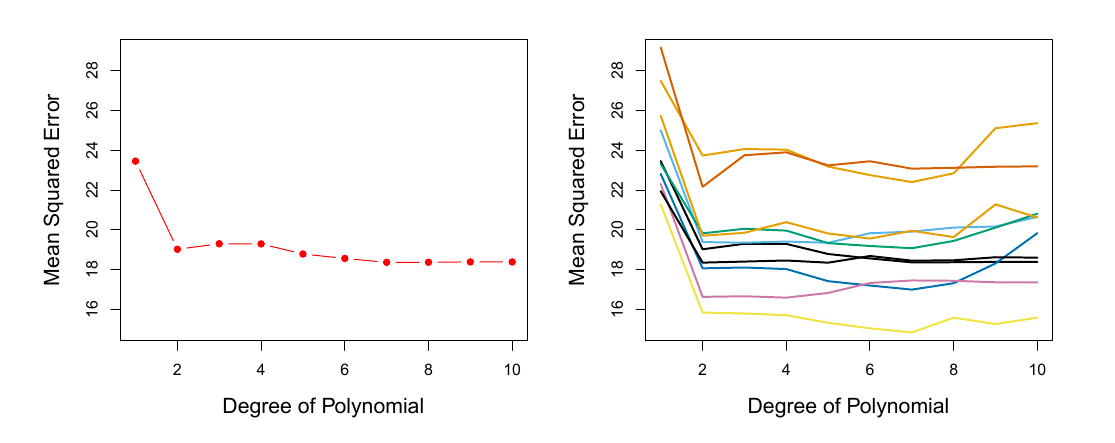
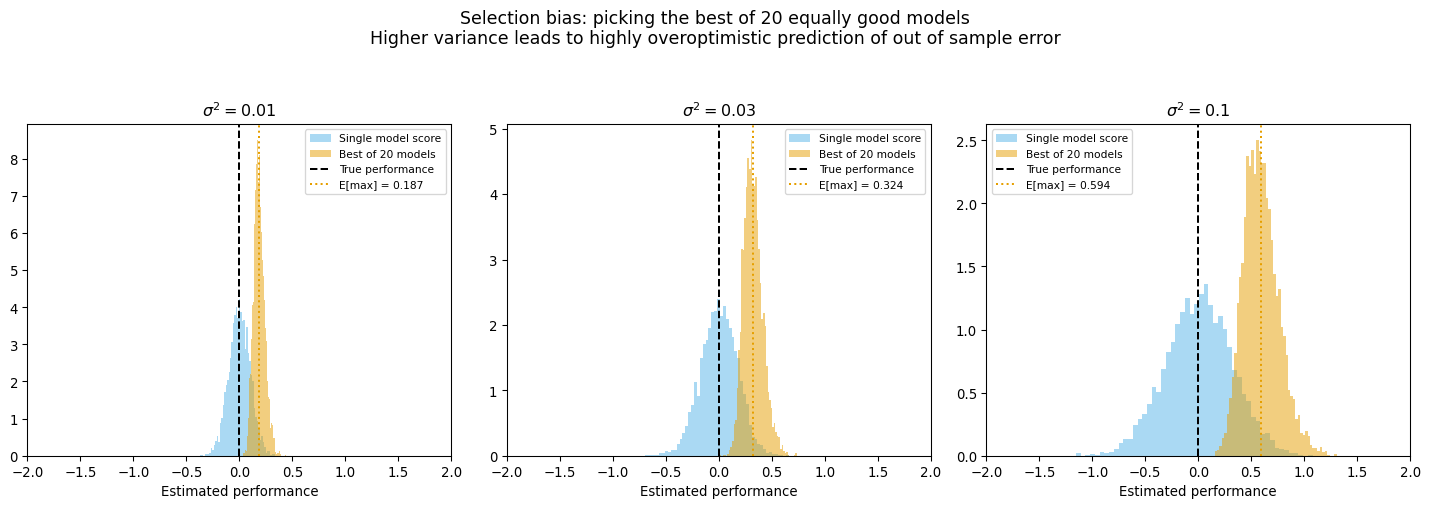
- Estimate of out of sample performance has high variance due to single split
![]()
ISLP 5.2
Train-Test Split Problems
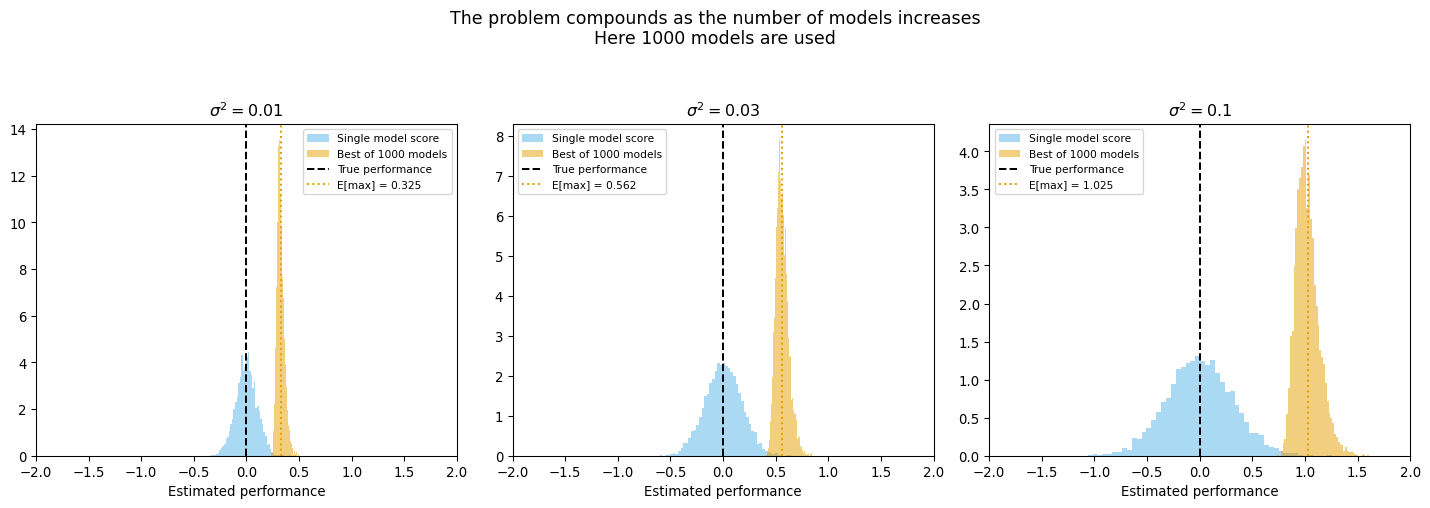
- High variance compounds multiple-comparison issue
![]()
Train-Test Split Problems
- High variance compounds multiple-comparison issue
![]()
Train-Test Split Problems
- Estimated accuracy is based on a model fit to less than the full data
- Can lead to understimated accuracy
- Data Inefficient
- Sensitivity to rare classes
Cross Validation
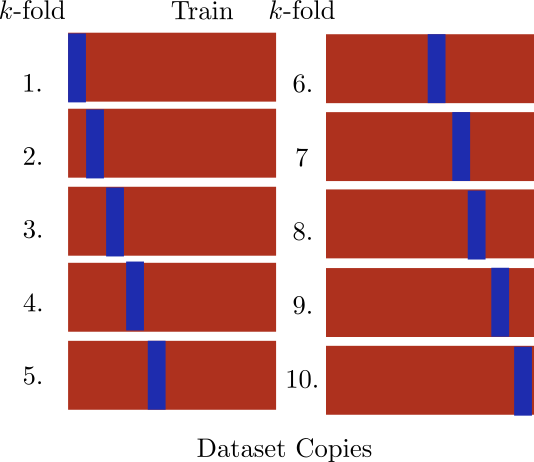
- Cross Validation divides data into “folds”
- Fit on \(k-1\) folds
- Estimate error on \(k\)th fold
- Repeat and then average
Cross Validation Disadvantages
- You have to fit your model multiple times (potential dealbreaker)
- How accurate is your estimate of accuracy? Now it is subtle
- Data leakage issues are more subtle
Leave One Out Cross-Validation (LOO-CV)
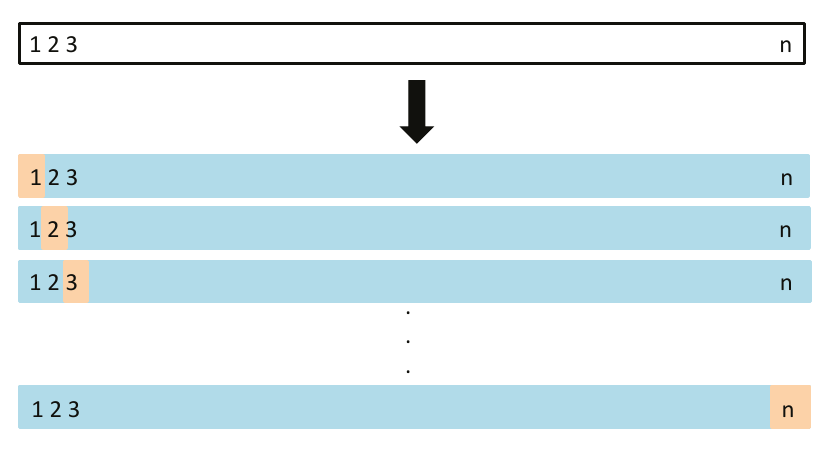
- Each “fold” has a single point
- Train entire model on \(n-1\) points, test on \(1\), repeat
![]()
LOO-CV Tricks
- Refitting model over and over sounds horrendous… but,
- There are tricks to get ‘LOO-CV’ for free
Linear Models
\[
\mathrm{CV}_n = \frac{1}{n}\sum_{i=1}^n \frac{\left(y_i - g_{\mathrm{full}}(\mathbf{x}_i)\right)^2}{1-h_i}
\]
- Leverage \(h_i = \mathbf{x}_i^T(X^TX)^{-1}\mathbf{x}_i\)
LOO-CV Tricks
- Refitting model over and over sounds horrendous… but,
- There are tricks to get ‘LOO-CV’ for free
Linear Models
\[
\mathrm{CV}_n = \frac{1}{n}\sum_{i=1}^n \frac{\left(y_i - g_{\mathrm{full}}(\mathbf{x}_i)\right)^2}{1-h_i}
\]
- ‘sklearn’s ’RidgeCV’ does this automatically
LOO-CV Tricks
- Refitting model over and over sounds horrendous… but,
- There are tricks to get ‘LOO-CV’ for free
Bayesian Models
- This can be approximated for any Bayesian model using Pareto Smoothed Importance Sampling
- See the arViz package
k-Fold Cross Validation
- For \(k\)-fold, error estimate is:
\[
\mathrm{CV}_k = \frac{1}{k}\sum_{i=1}^k \mathrm{MSE}_k
\]
How many folds?
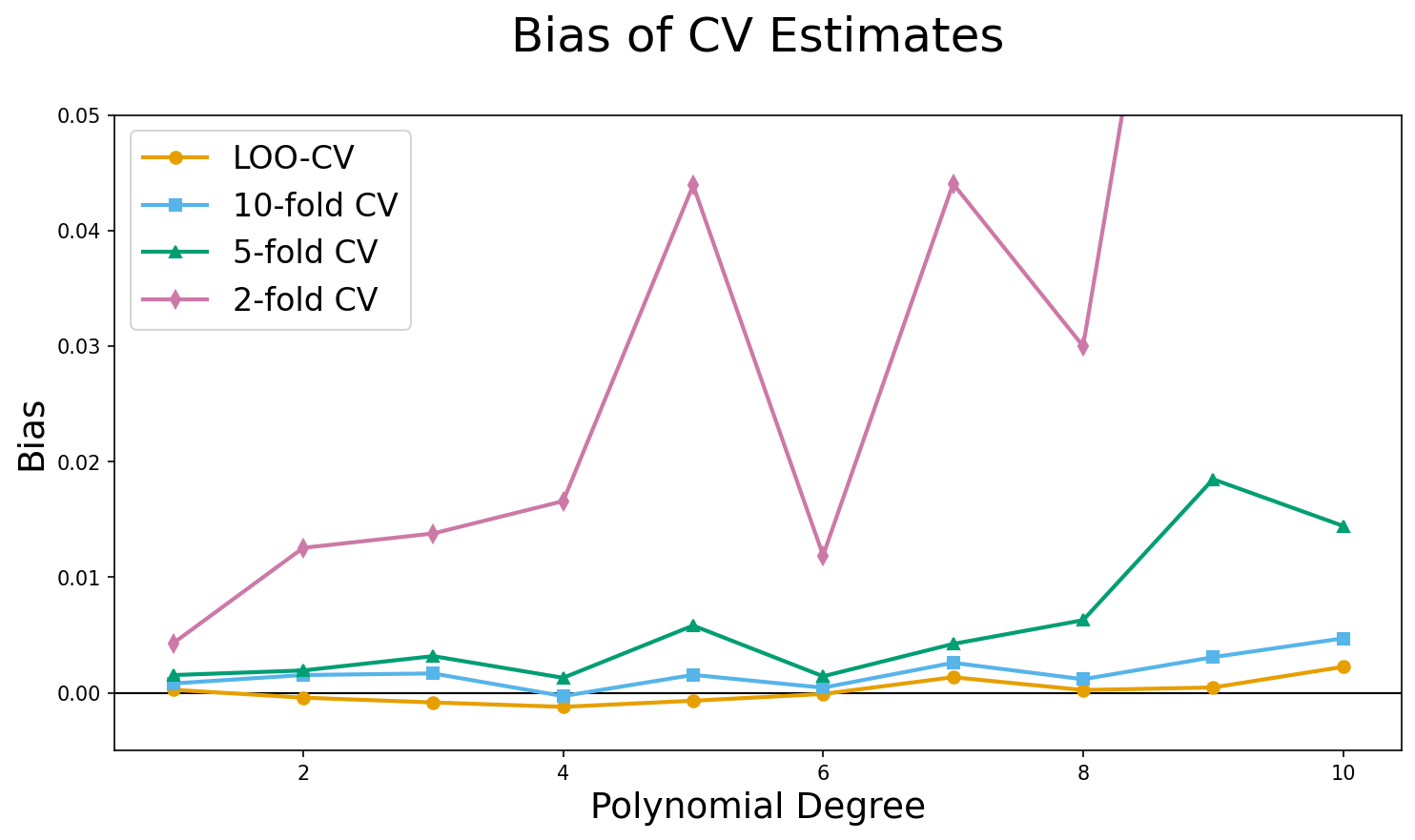
- ‘LOO-CV’ is least biased
- Because it uses more data per model, the models are closer to the full model
![]()
How many folds?
![]()
- Your textbook argues that “variance” increases with \(k\), in a kind of bias-variance trade-off
- But they don’t give any evidence
How Many Folds?
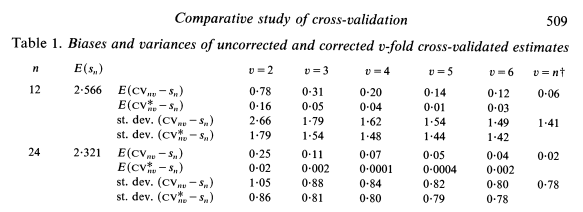
- It has been proven mathematically at least for linear regression, that there is no trade-off!
- ‘LOO-CV’ has lowest variance and lowest bias
![]()
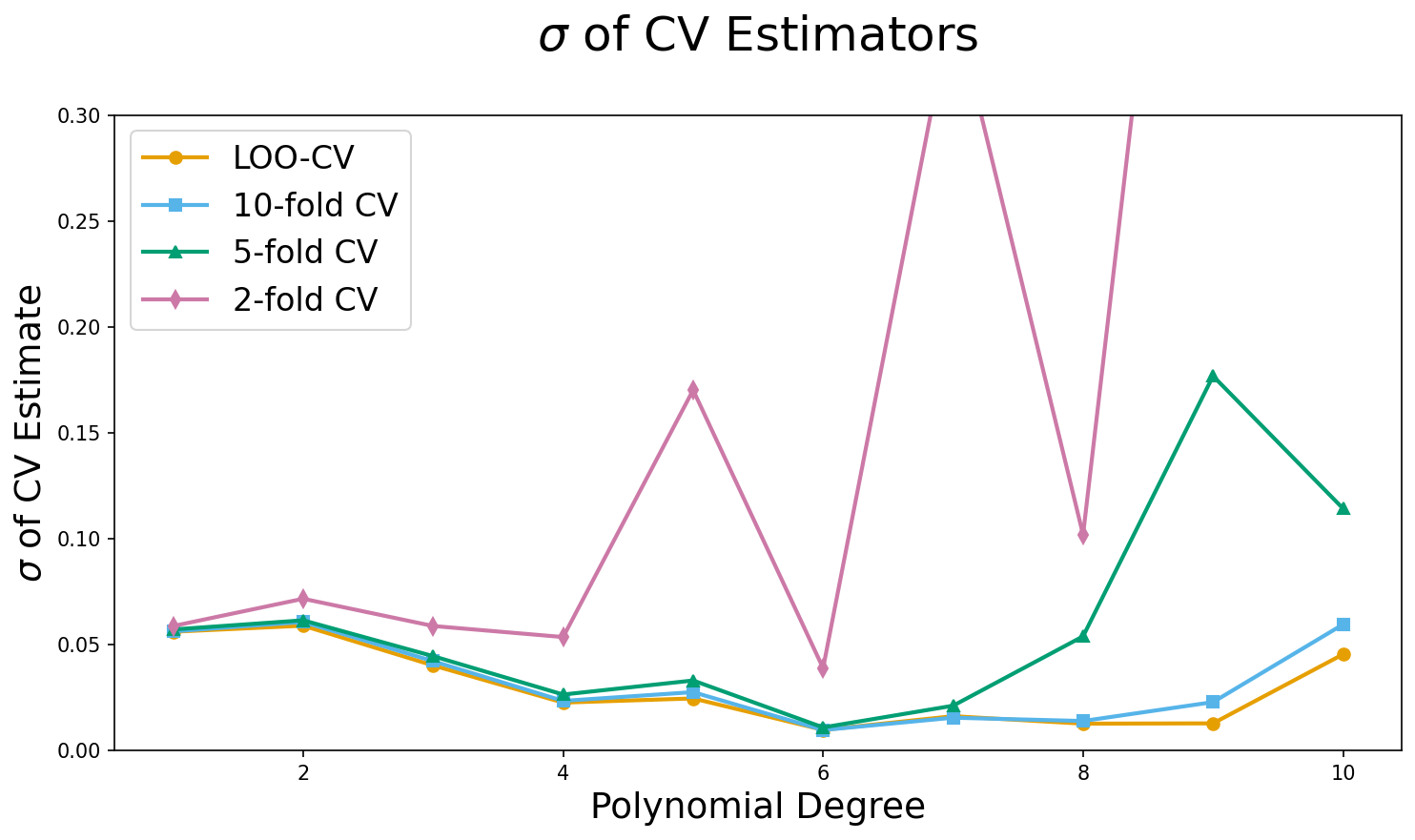
‘LOO-CV’ variance?
- I tried it with repeated experiments using known data generating process
- ‘LOO’ is best
![]()
How Many Folds?
- Decide based on how much data you have and if you have a fomula to get ‘loo’
- \(k=5\) is a bit more than 5x
- Difference to ‘loo’ is proportional to your data
- At same time, bias and variance advantages of ‘LOO-CV’ decrease with more data
Validation, k-fold or LOO-CV?
- If you have no other choice, validation
- If you can, ‘LOO-CV’
- Otherwise, \(k=5\) is a great choice that is a sweet spot of computational expense and diminishing returns to bias and variance
What Metric to Use?
![]()
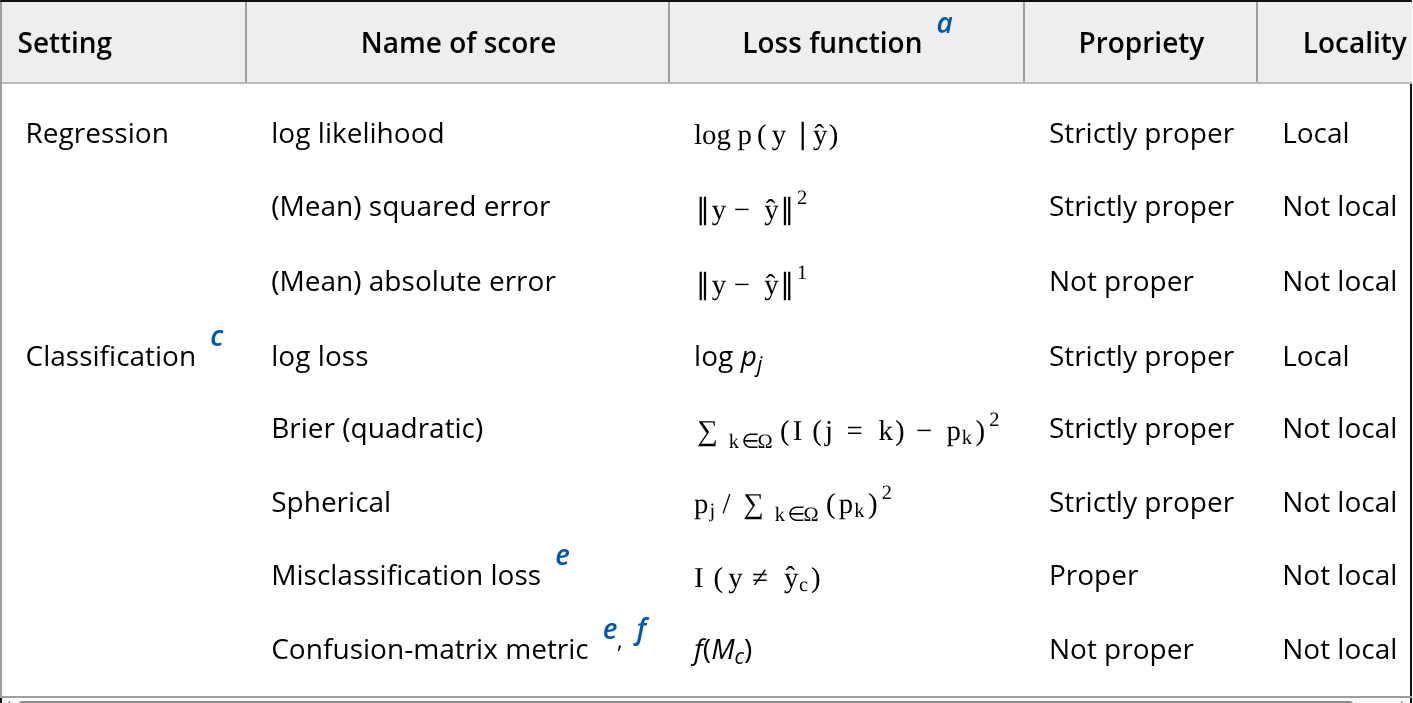
Yates 2022 et al
Proper and Local Metrics
Proper Metric: This is one where if your model was the data generating process it would be scored highest
Local Metric: For each observation, contribution to score only rates to probability of predicting correct class
Metric Selection Advice
- If you have likelihood, use ‘log’ scoring
- Both classification and regression
- If costs are well known, you can construct a custom metric based on that
- If ranking is key, AUC of ROC curve or similar is not bad
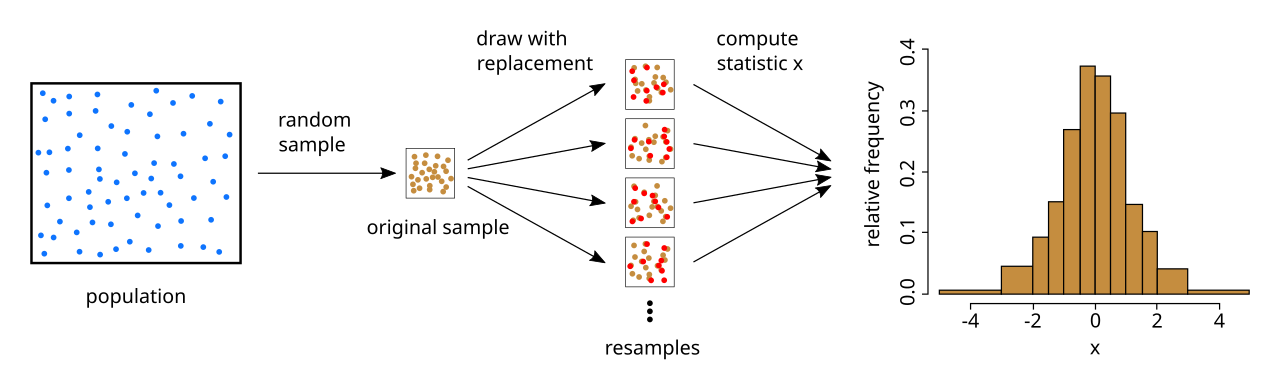
The Bootstrap
- Motivation: For complicated models there aren’t “statistics” we can use to derive uncertainty estimates
Bootstrap: Create a lot of fake datasets by resampling from your data with replacement
- Get “samples” from your model, empirical confidence intervals
The Bootstrap
![]()
wikipedia
The Bootstrap
- Resample “B” times, coefficient or prediction \(c_r\) for each boostrap \[
SE_{c} = \left(\frac{1}{B-1}\sum_{r=1}^B\left(c_r - \bar{c}\right)^2 \right)^{1/2}
\]
Bootstrapping is Expensive
- Convergence rate is \(\frac{1}{\sqrt{B}}\)
- Slower for tails, need more reps for confidence intervals
- Main use cases are complicated, but not computationally intensive models
- Various types of regression
- Tree based methods (“bagging” is based on bootstrap)
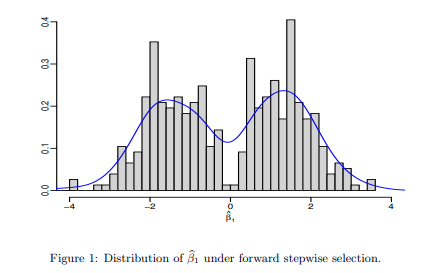
No Inference after Model Selection
- Suppose you care about the values of the model coefficients
- You have a family of different models, and you use cross-validation to pick the “best” one
- Then you look at the model coefficients of the best model
- Smart?
No Inference after Model Selection
- Winner’s Curse- winning model will only include features with a high coefficient
- Values biased away from 0 and standard errors biased low
![]()
Bias Correction
- Cross-Validation penalizes more complex models because smaller than full dataset is used
- If \(S_g\) is the score of a model \(g\), the bias correction is:
\[
S_g^* = S_g +\frac{1}{n}\sum_{i=1}^n \nu_i, \\
\nu_i = L(y_i,g(\mathbf{x}_i)) -\frac{1}{k}\sum_{j=1}^k L(y_i,g_j(\mathbf{x}_i))
\]
One Standard Error Rule
- Overfitting is something that can occur in model selection
- When you compare a lot of models, the ones that get selected have all there variables as important, some due to chance
![]()
One Standard Error Rule
- Compute standard error of Score estimate of best model: \[
SE_{CV} = \frac{\hat{\sigma}}{\sqrt{n}}
\]
- Pick simplest model with CV score within one standard error of the best model average